// 10 June 2026
The summer drought: why high-latitude DSO imaging stops for three months
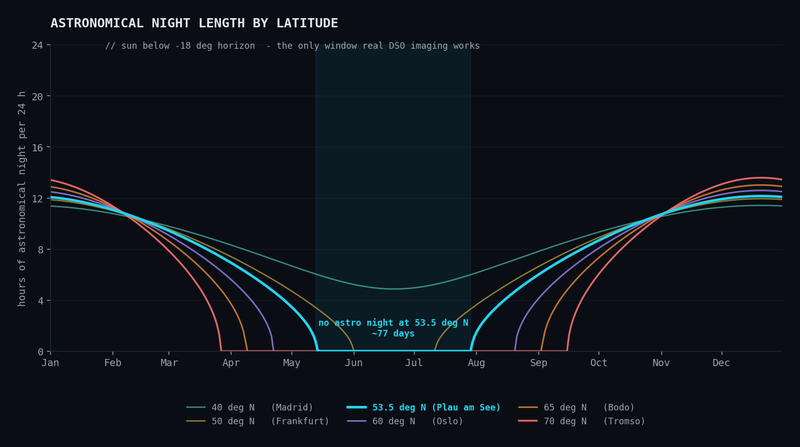
At 53.5° N the sky never goes truly dark from mid-May to early August. A look at why, with the geometry, the latitude curve, and the strategies that survive the drought.
It is the third week of June. The sky over Plau am See never really got dark — at 1 a.m. there is still a copper bruise on the northern horizon, and by 2:30 it is already brightening again. The mount is parked, the camera is in its bag, and the deep-sky targets I had planned for tonight stay unobserved. This happens every summer at high northern latitudes, and there is no fixing it with better gear. The problem is geometry.
What "astronomical darkness" actually means
Astronomers split the period between sunset and sunrise into four bands, defined by how far the sun sits below the horizon:
- Civil twilight — sun between 0° and -6°. Bright enough to read outside.
- Nautical twilight — sun between -6° and -12°. The brighter stars are visible; the horizon is still discernible at sea.
- Astronomical twilight — sun between -12° and -18°. The sky looks dark to the eye, but a long exposure picks up a measurable skyglow.
- True night — sun beyond -18°. The sky background is at its natural minimum (modulo light pollution and airglow). This is the only regime where most deep-sky imaging genuinely works.
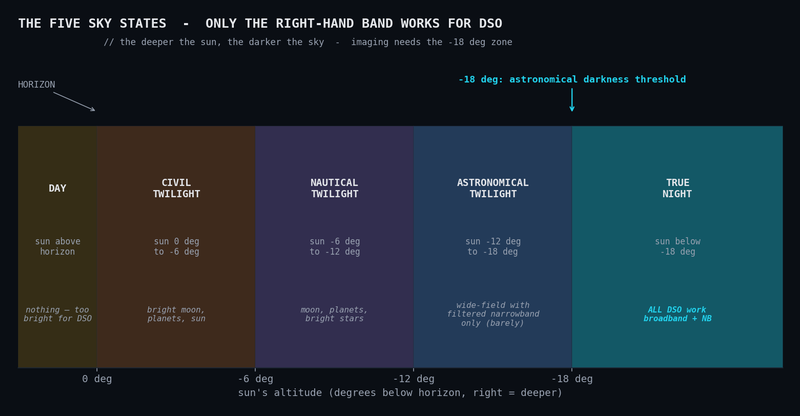
Why -18°? Because below that depth the sun no longer adds detectable light to the upper atmosphere. Above it, even a few degrees of solar altitude lifts the sky background by 0.5 to several magnitudes per square arcsecond — small in human terms, catastrophic for the faint nebulosity we are trying to integrate out of the noise.
Why latitude is the lever
At the summer solstice the sun reaches a declination of +23.44°. Whether it ever falls 18° below your horizon at solar midnight depends on a single sum:
astronomical night exists ⇔ latitude + 23.44° ≤ 72° ⇔ latitude ≤ 48.56° N
Once you cross ~48.5° N — Munich, Vienna, the southern tip of England — the sun no longer dips that deep on midsummer night. Every degree of latitude you add stretches the window of "no astro night" by roughly two weeks at each end.
You can read the cost of latitude directly off the chart. Madrid never loses true night entirely; Frankfurt skims it; Plau am See drops to zero hours for about eleven weeks; Tromsø is essentially closed for business from late April through mid-September.
The summer drought, in days per year
Aggregating the curve into a single number — "how many calendar days of the year have zero astronomical darkness" — produces a cleaner mental model:
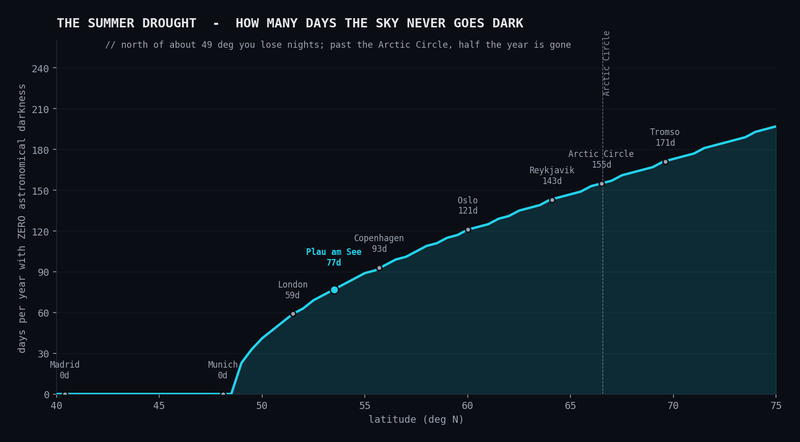
From here it is obvious why southern observatories exist where they do, and why high-latitude amateurs cram their entire DSO season into roughly seven months. At 53.5° N I lose 77 nights a year before clouds and the moon take their cut. Anyone north of the Arctic Circle loses more than five months — half the calendar.
What you can (and cannot) photograph during the drought
"No astronomical night" does not mean "no astrophotography." It means the toolbox shrinks dramatically. From most workable to least workable in deep twilight:
- Solar and lunar imaging — unaffected. The brighter the target, the less the sky matters.
- Planetary — Jupiter, Saturn, Mars are fine; sky brightness is irrelevant on a focused planetary stack.
- Bright wide-field constellations — for journalistic shots, not for faint nebulosity.
- Narrowband Hα / SII / OIII — the only DSO technique that meaningfully survives twilight. A 3 nm Hα filter rejects almost all twilight skyglow; you can pull off OK Hα data even at nautical depth, especially in the deepest hour around solar midnight.
- Broadband galaxies, faint reflection nebulae, dim globulars — forget it. The signal-to-noise ratio collapses; integration time stops buying you anything.
Strategies for high-latitude astrophotographers
What survives the drought, beyond just waiting for September:
- Aggressive narrowband — stockpile Hα/SII/OIII subs from May through July. They will form the spine of your fall composites once you can add the broadband RGB stars under proper night.
- Single-shot remote rigs in the south — services like a hosted observatory in Spain or Chile let you keep imaging deep-sky from a desk during the European drought. Not cheap, but neither is gear that sits idle for three months.
- Plan around the deepest dip — even at 53.5° N the period from May 20 to July 20 is the worst. The shoulder weeks (early May, early August) still give 1–2 usable hours of true night and are a good time for short-integration projects.
- Pre-process and re-process — every astrophotographer has a backlog of half-finished stacks. The drought is exactly when to clear it. Three months of clear daylight is also enough to rebuild your processing toolchain, document your workflow, or finally automate calibration.
- Travel south for new moon — a long weekend at ~45° N in mid-June can still yield a real imaging session. It is not nothing.
- Daytime astronomy — solar Hα is a different hobby living in the same garden. Worth picking up if you have not.
The flip side: winter's gift
Latitude cuts both ways. The same geometry that closes the sky in June pries it wide open in December: at 53.5° N the longest astronomical night runs about 14.5 hours. That is more dark sky in one December night than two summer-shoulder nights combined, and it is when high-latitude astrophotographers do their best work — Orion, the winter Milky Way, the Pleiades, the California Nebula, all visible during a single long, cold session.
It is a strange rhythm to make peace with. The hobby has a closed season, like fishing, except its closed season is the months when the weather is most pleasant and the open season is when you are standing outside at -8 °C at 2 a.m. waiting for a 5-minute sub. Most of us have decided that is a fair trade.
For now: the mount is in the shed, the captures folder is being reorganised, and I am calibrating darks at 22 °C with the bedroom blinds shut. It will get dark again in August.
// comments
Sign in with Google to leave a comment. Comments are moderated; first time may take a moment to appear.