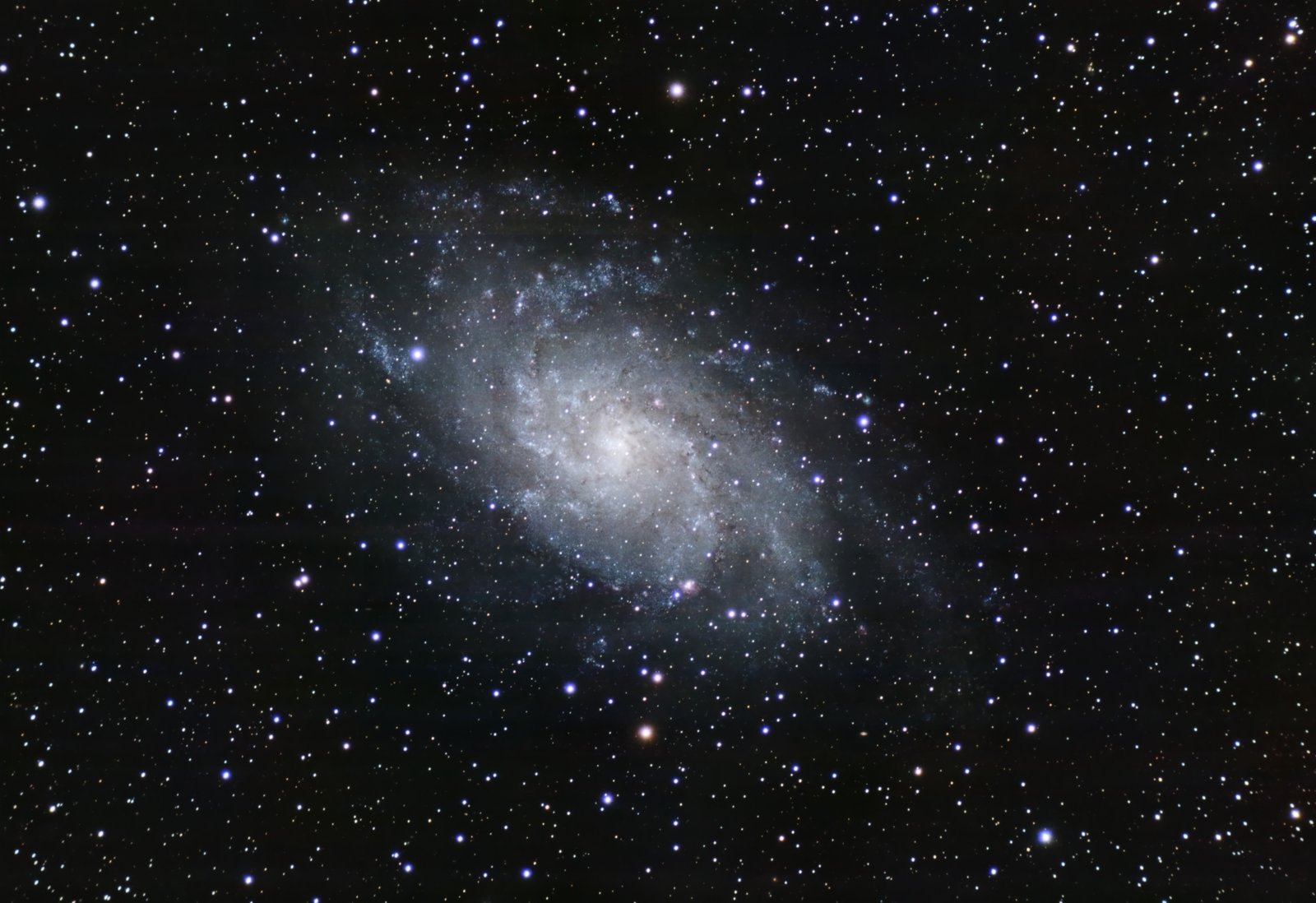
M 33 — Triangulum Galaxy Star Map
The blue stars on Bode's Galaxy
They are ordinary Milky Way stars sitting in front of M81, not explosions. All four are catalogued, with Gaia parallaxes putting them 1,100 to 1,800 light years away. M81 is 11.8 million light years away.
Their real colours are yellow-white to yellow (late F and G types, similar to the Sun). In the first stretch they looked blue: the telescope focuses blue light into a 27 % wider disc than red and green, and the clipped white cores left only that blue halo visible.
This version has the star colours rebuilt. Stars were separated with StarNet, coloured from each star's total light in the colour-calibrated data, and re-stretched without clipping. The orange giants now look orange.
| Star | V | B−V | Est. type | Distance |
|---|
No new supernova
I found no reported supernova or nova in M81 for 2026. The last one bright enough for amateur scopes was SN 1993J, marked on the map; it has faded below magnitude 20. Every bright point on the galaxy matches a known foreground star.
The bluish knots strung along the arms are not stars either. They are clusters of young, hot stars and star-forming regions inside M81, each spanning hundreds of light years.
The two faint smudges
Both are real galaxies of the M81 group, about 12 million light years away and far fainter than M81 itself.
Holmberg IX, the one closer to M81, is a young dwarf irregular galaxy, probably formed from gas pulled out of M81. KDG 61, near the top edge, is a dwarf spheroidal galaxy made of old stars. Both sit at their catalogue positions within a few arcseconds.
Star data: SIMBAD (identifiers, V and B magnitudes, catalogued spectral types, object types) and Gaia DR3 via GAVO (parallax, colour, proper motion, radial velocity). Temperature, luminosity, radius and estimated spectral class come from Gaia colour and distance using the Pecaut & Mamajek main-sequence table, so they are approximate, especially for giants. The image is shown as Siril displays it (mirrored; north and east arrows at top left).