// 12 November 2026
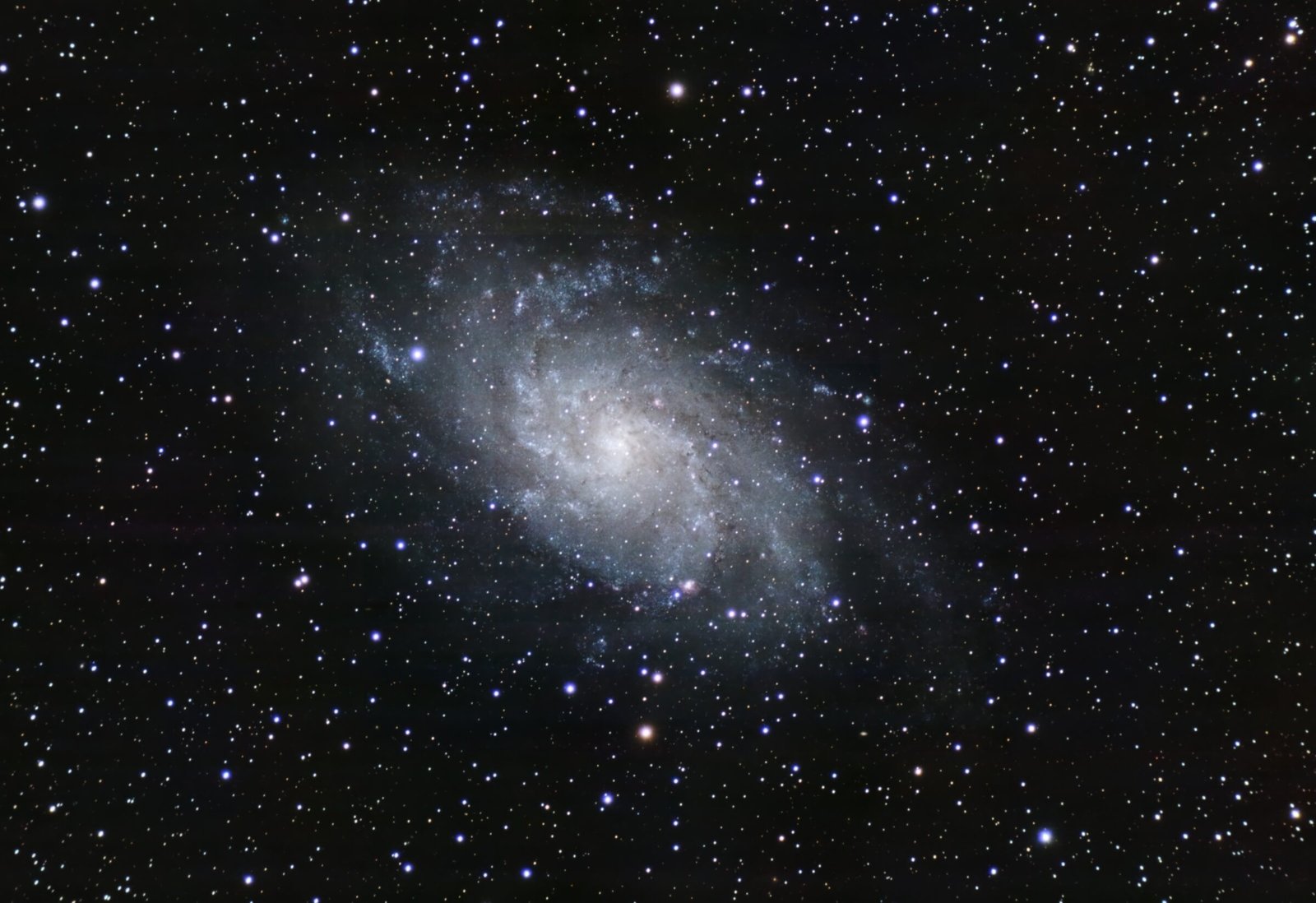
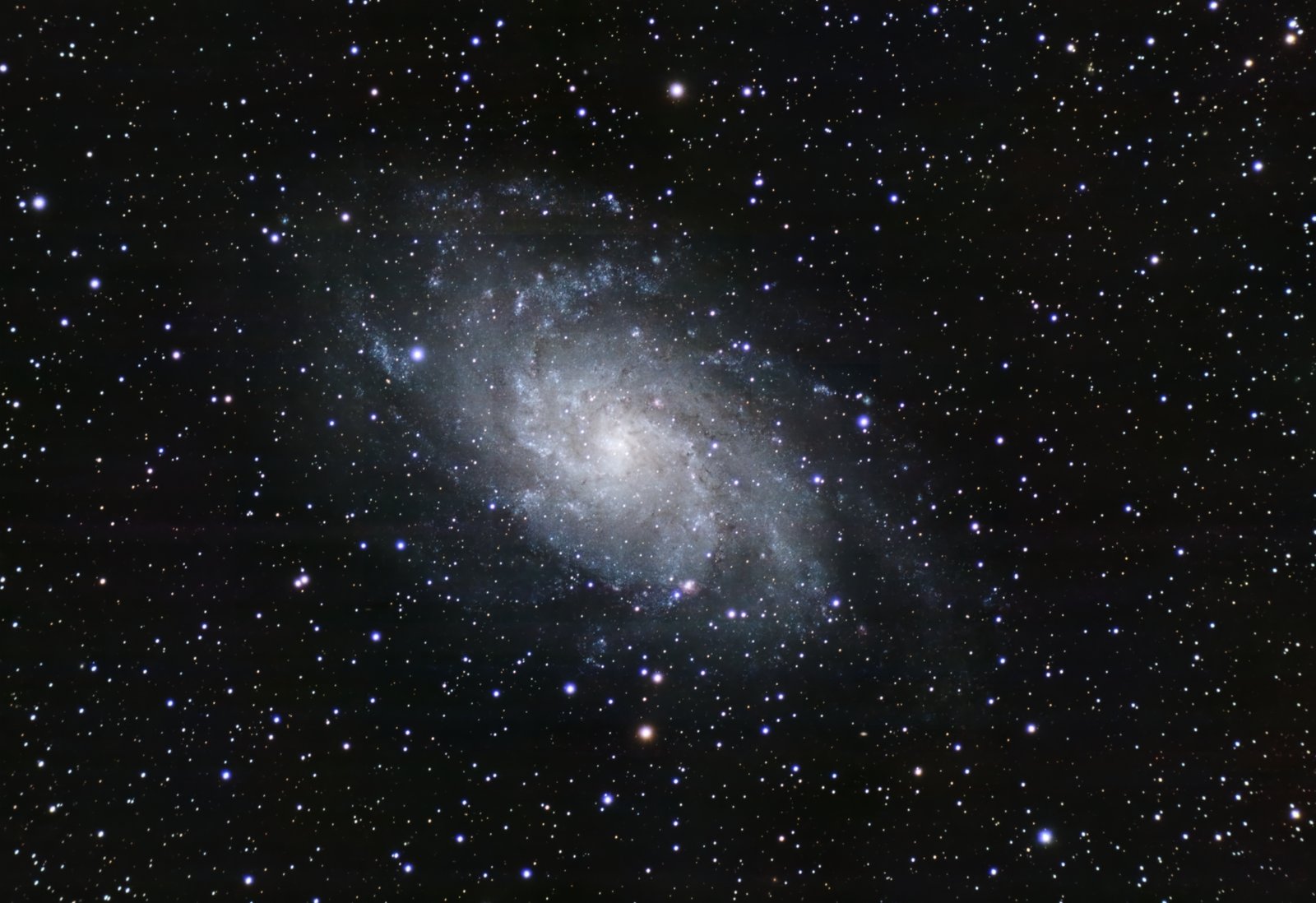
The Triangulum Galaxy (M33) — a Spiral With No Heart
The Triangulum Galaxy is the third-largest member of our Local Group, after Andromeda and the Milky Way, and from a properly dark site it is one of the most distant things the naked eye can see — its light has been travelling for about 2.7 million years. It is an odd spiral: almost all disc and almost no central bulge, seen very nearly face-on, so its arms and glowing star nurseries spread right across the frame. This is a single session from the backyard in northern Germany with a small refractor and a colour camera.
Explore the field
I made an interactive star map of this image. Hover over any of the 120 marked stars to see what it is — its spectral type, distance, temperature and how much brighter or larger than the Sun it is. The data comes from SIMBAD and Gaia. Almost every sharp point of light here is a foreground star in our own Milky Way, a few hundred to a few thousand light-years away; the galaxy and its pink nurseries behind them are 2.7 million light-years off. The map also marks M33 itself and its brightest star-forming regions.
The glowing pink knots
The magenta patches strung along the arms are HII regions: clouds of hydrogen set glowing by clusters of hot young stars. The largest, NGC 604, is one of the biggest stellar nurseries known anywhere — roughly 1,500 light-years across, about forty times the size of the visible Orion Nebula, and lit by more than 200 massive stars. It is so bright that it earned its own NGC catalogue number even though it sits inside another galaxy. Several of its smaller siblings — NGC 595, 592 and 588 — did too.
A galaxy with no heart
Most spirals have a bright central bulge of old stars. M33 barely has one — it is nearly pure disc, which is part of why it looks so delicate. It is also a close companion of the much larger Andromeda Galaxy; the two are slowly drawing together, and in a few billion years all three of us — M31, M33 and the Milky Way — may end up as one.
Three hours of one-shot-colour data, calibrated with matching darks and a flat, stacked in Siril and then finished by hand: background extraction, colour calibration, stretch and a little star reduction so the galaxy could breathe.
// comments
Comments are moderated; first time may take a moment to appear.