← gallery
SH2-185 · IC 63 / IC 59 · Emission + reflection nebula
The Ghost of Cassiopeia
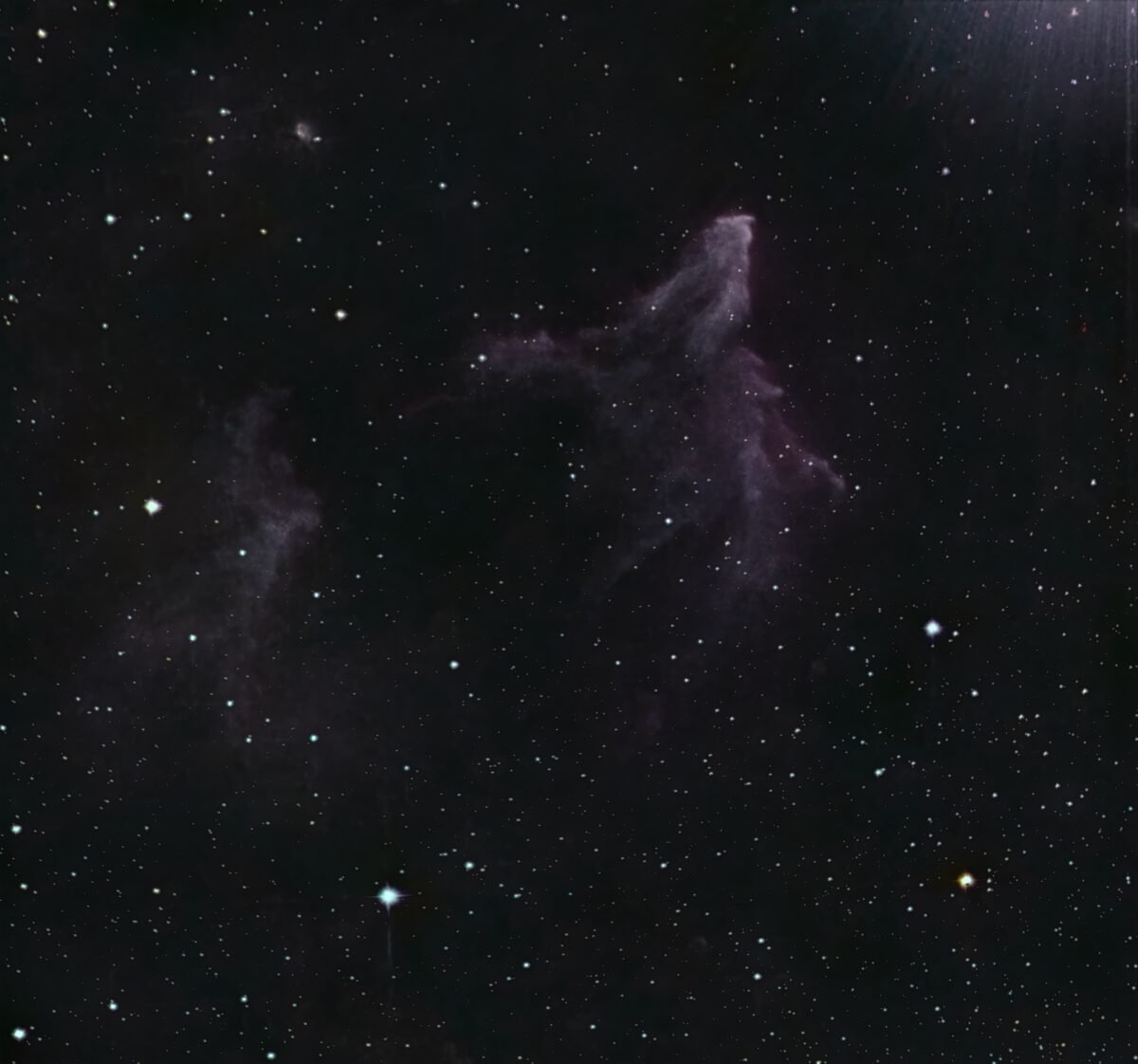
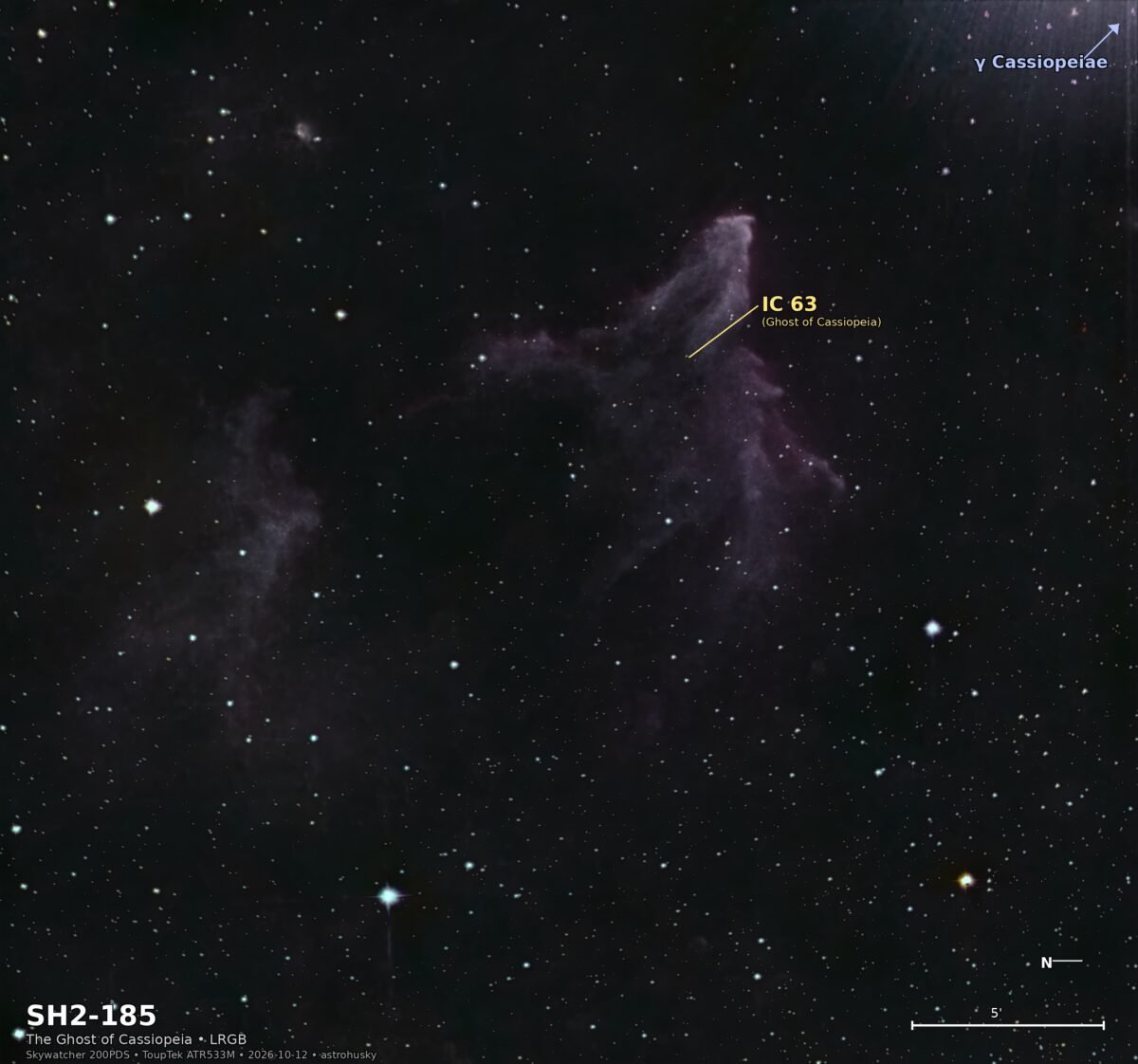
A pair of dusty clouds beside the brilliant star γ Cassiopeiae — IC 63 and IC 59, the Ghost of Cassiopeia. The star both lights the dust blue and tears its hydrogen apart at the edges, where it glows red.
IC 63 and IC 59 are two faint clouds of gas and dust lying only three to four light-years from γ Cassiopeiae, the brilliant blue-white star at the centre of the "W" of Cassiopeia. γ Cas is a Be star roughly 550 light-years away and tens of thousands of times more luminous than the Sun, and its fierce ultraviolet radiation is slowly destroying both clouds — which is precisely what makes them glow.
The two nebulae answer that radiation in different ways. IC 63, the brighter "ghost" closer to the star, is near enough that its hydrogen is being ionised: it shines in red Hα along the edge facing γ Cas, where an advancing ionisation front is photo-evaporating the cloud. IC 59, farther out, is dominated instead by blue starlight scattering off its dust. Together the pair traces the shape that earns the nickname — the Ghost of Cassiopeia.
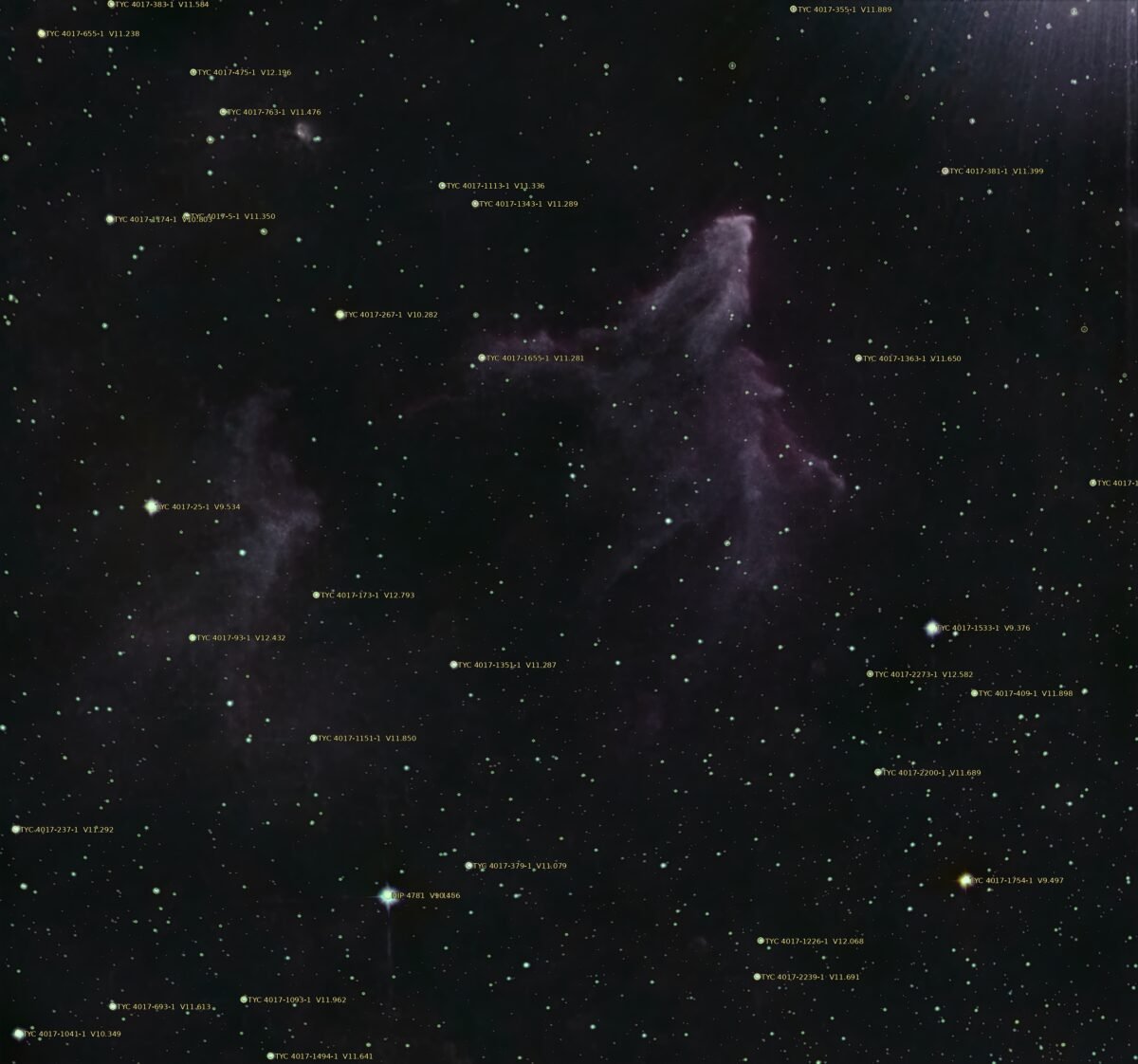
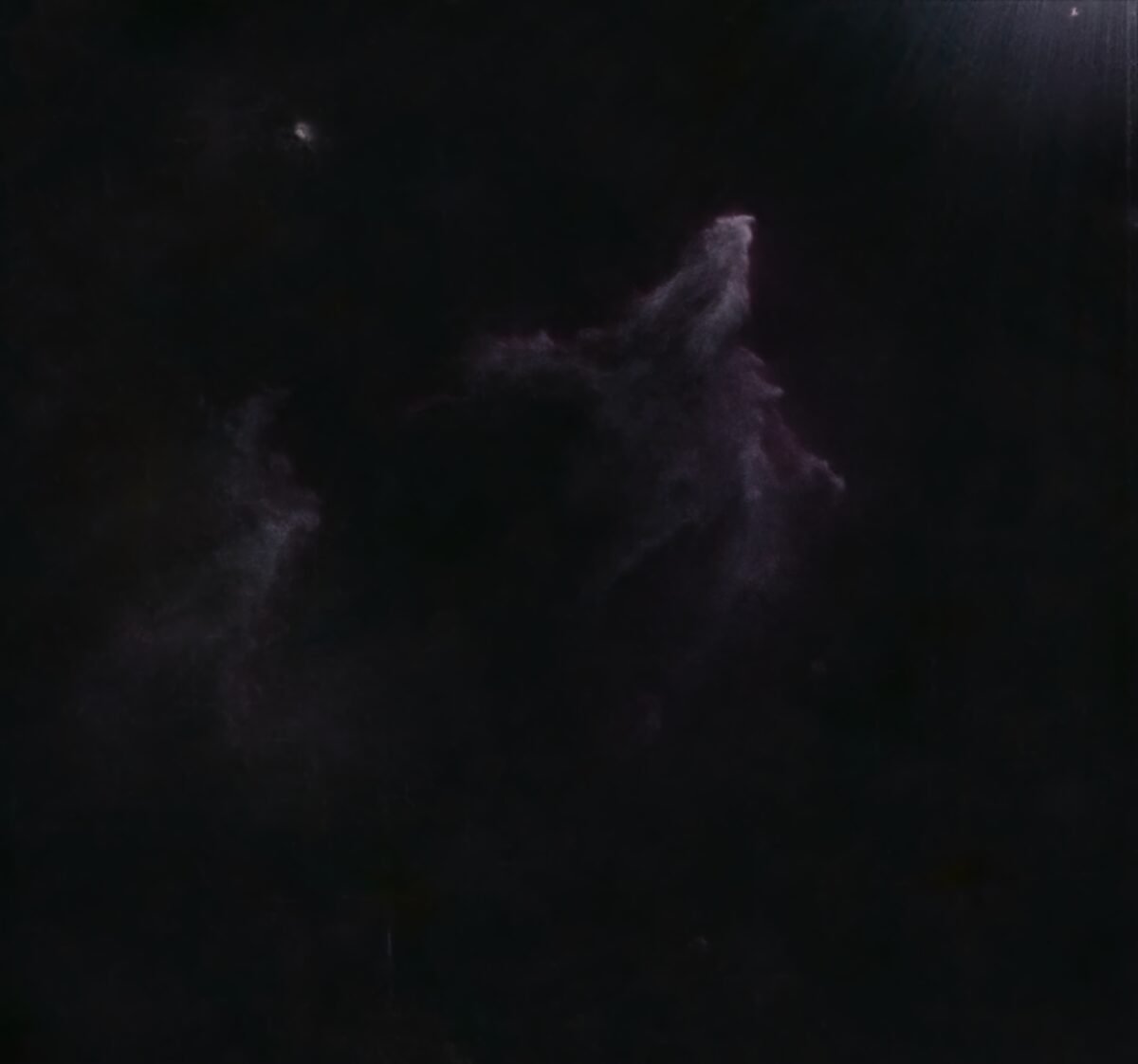
This LRGB view was taken with a Sky-Watcher 200PDS and a cooled ToupTek ATR533M over a single night, 4.8 hours of luminance and colour combined. γ Cassiopeiae itself sits just beyond the top-right of the frame, so its glare was removed as a background gradient during processing, letting the delicate nebulosity be stretched without the whole field washing to magenta.
The two nebulae answer that radiation in different ways. IC 63, the brighter "ghost" closer to the star, is near enough that its hydrogen is being ionised: it shines in red Hα along the edge facing γ Cas, where an advancing ionisation front is photo-evaporating the cloud. IC 59, farther out, is dominated instead by blue starlight scattering off its dust. Together the pair traces the shape that earns the nickname — the Ghost of Cassiopeia.
This LRGB view was taken with a Sky-Watcher 200PDS and a cooled ToupTek ATR533M over a single night, 4.8 hours of luminance and colour combined. γ Cassiopeiae itself sits just beyond the top-right of the frame, so its glare was removed as a background gradient during processing, letting the delicate nebulosity be stretched without the whole field washing to magenta.
// imaging sessions
session // unassigned
// comments
Comments are moderated; first time may take a moment to appear.