// 10 November 2026
Bode’s and Cigar Galaxies (M81 & M82) — and Why My Orange Stars Turned Blue
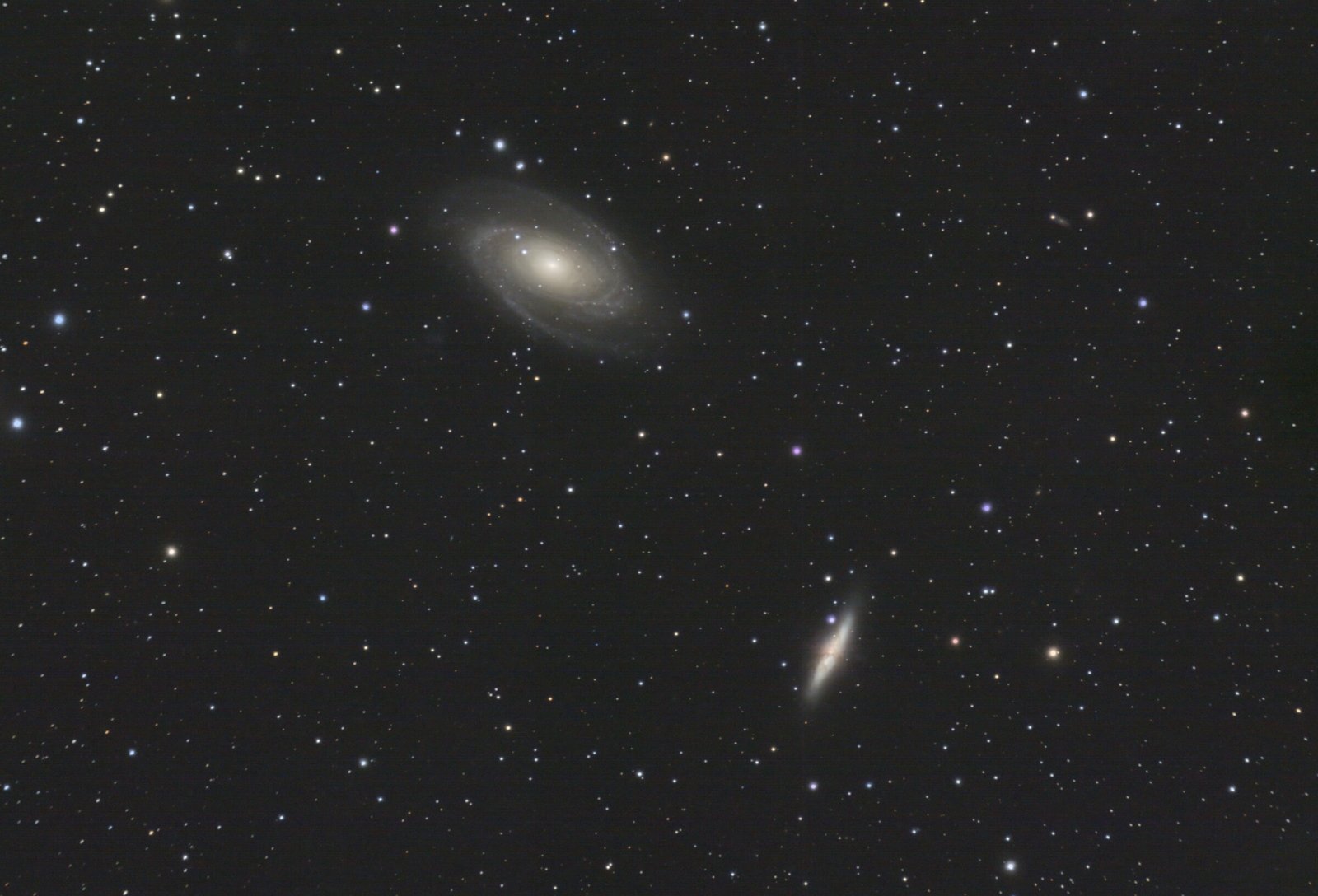
Bode’s Galaxy and the Cigar Galaxy are one of the classic pairs of the northern sky: a calm, grand-design spiral and an edge-on starburst galaxy less than a degree apart in Ursa Major. They are about 12 million light years away, and around 200 to 300 million years ago they passed close enough to reshape each other. This is a single night from the backyard in northern Germany, with a small refractor and a colour camera.
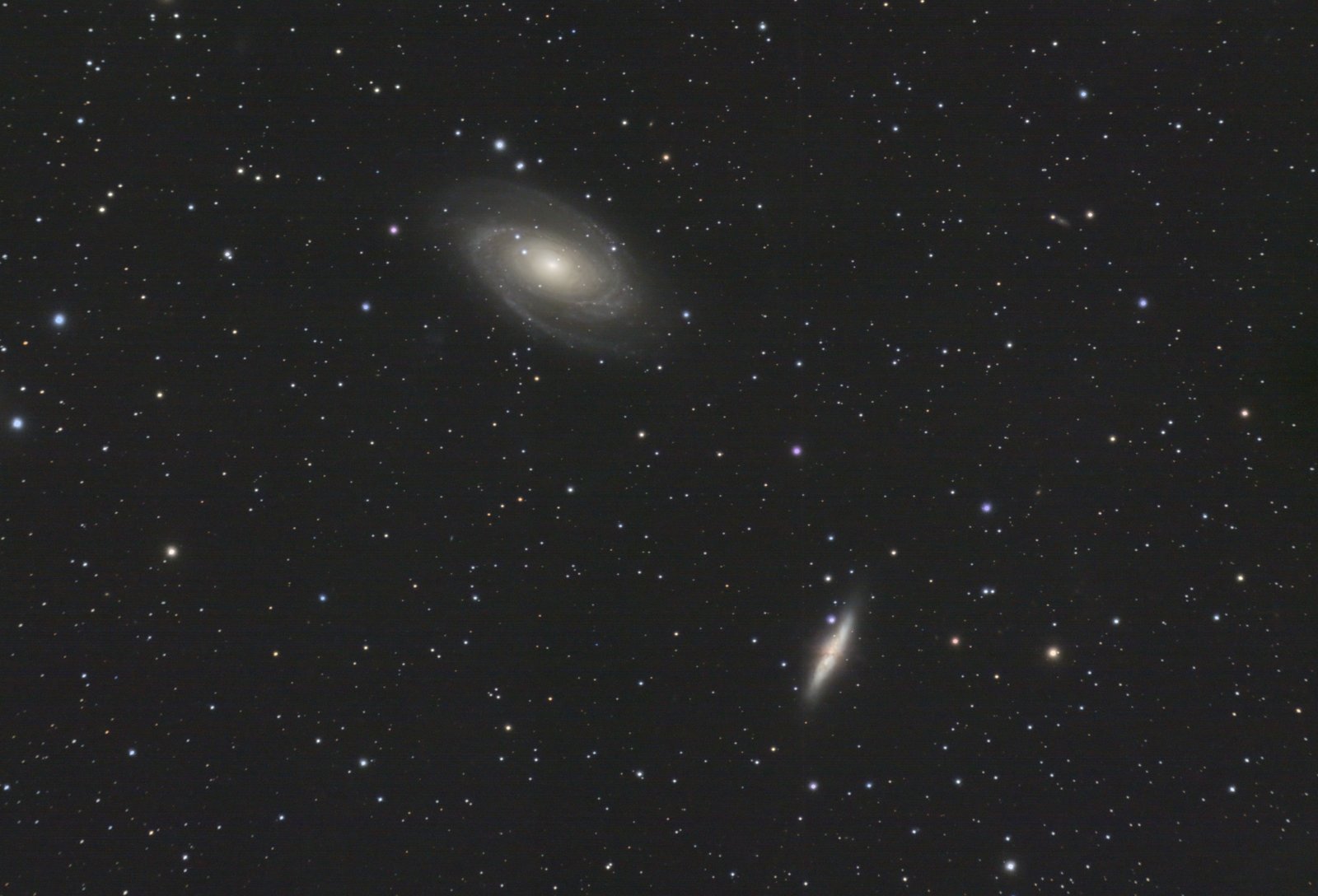
Explore the field
I made an interactive star map of this image. Hover over any of the 103 marked stars to see what it is: its spectral type, how far away it is, its temperature and how much brighter or bigger than the Sun it is. The data comes from SIMBAD and Gaia. Most of the bright stars in the field are Milky Way stars a few hundred to a few thousand light years away, so their light left them while the pyramids or medieval castles were being built. The galaxies behind them are 12 million light years away.
Two faint galaxies hiding in the frame
Next to M81 there are two very faint smudges. I first wondered whether they were reflections, but both sit exactly where catalogues place two small members of the M81 group. Holmberg IX is a young dwarf galaxy that probably formed from gas pulled out of M81. KDG 61 is a dim ball of old stars orbiting M81. Neither is anywhere near as bright as the big two, but a 75-minute stack from a 72 mm refractor still records them.
Why my orange stars turned blue
After my first stretch, several bright stars on and around M81 looked strikingly blue. I checked whether something new had appeared in the galaxy, but the catalogues say otherwise. They are ordinary foreground stars, yellow-white to orange, including a few K-type giants that should look clearly orange.
The cause was a mix of optics and processing. Measured over about a hundred stars, the telescope puts blue light into a disc about 27 % wider than red and green, so every star gets a blue rim. The stretch then pushed the star centres to pure white, which left the blue rim as the only visible colour. To fix it I separated the stars from the galaxies with StarNet, took each star’s colour from its total light in the colour-calibrated data (the rim spreads the blue light but doesn’t change how much there is), and stretched the stars again without letting their cores clip. The handful of stars that were saturated in the raw data got their colour from Gaia measurements, converted with the colour relation of the other stars in this same image.
What went into it
- Telescope: Sky-Watcher Evostar 72ED (about 430 mm focal length)
- Camera: ToupTek 183CA colour camera, uncooled, gain 100
- Mount and control: Sky-Watcher Wave 150i with the ToupTek StellaVita
- Subs: 15 × 300 s = 1.25 h. Guiding failed later in the night, so 31 trailed frames and 6 frames from a rotated first session were left out.
- Calibration: matching darks (same gain and exposure) and flats. The darks removed a strong amp glow along one edge; the flats removed dust shadows.
- Processing: Siril (stacking, photometric colour calibration, StarNet star separation), VeraLux stretch, Cosmic Clarity noise reduction
M81 has hosted a famous supernova, SN 1993J, which reached magnitude 10.5 in 1993. It has long faded, and nothing new is shining in the galaxy in this image. More images of Bode’s Galaxy are in the M81 gallery album.
// comments
Comments are moderated; first time may take a moment to appear.