Session Logs
KStars / Ekos session logs
For transparency — and for anyone studying real-world guiding and autofocus performance — here are the Ekos .analyze session logs from the astrohusky imaging rig: 200 sessions across 47 nights (May–September 2026). They contain telemetry only (guiding RMS, mount coordinates, autofocus runs, captures, temperature) and no location data. Open them in KStars (Ekos → Analyze), or parse them as CSV.
⬇ Download all session logs (.tar.gz, 3.2 MB)
StellaVita rig — guiding & tracking performance
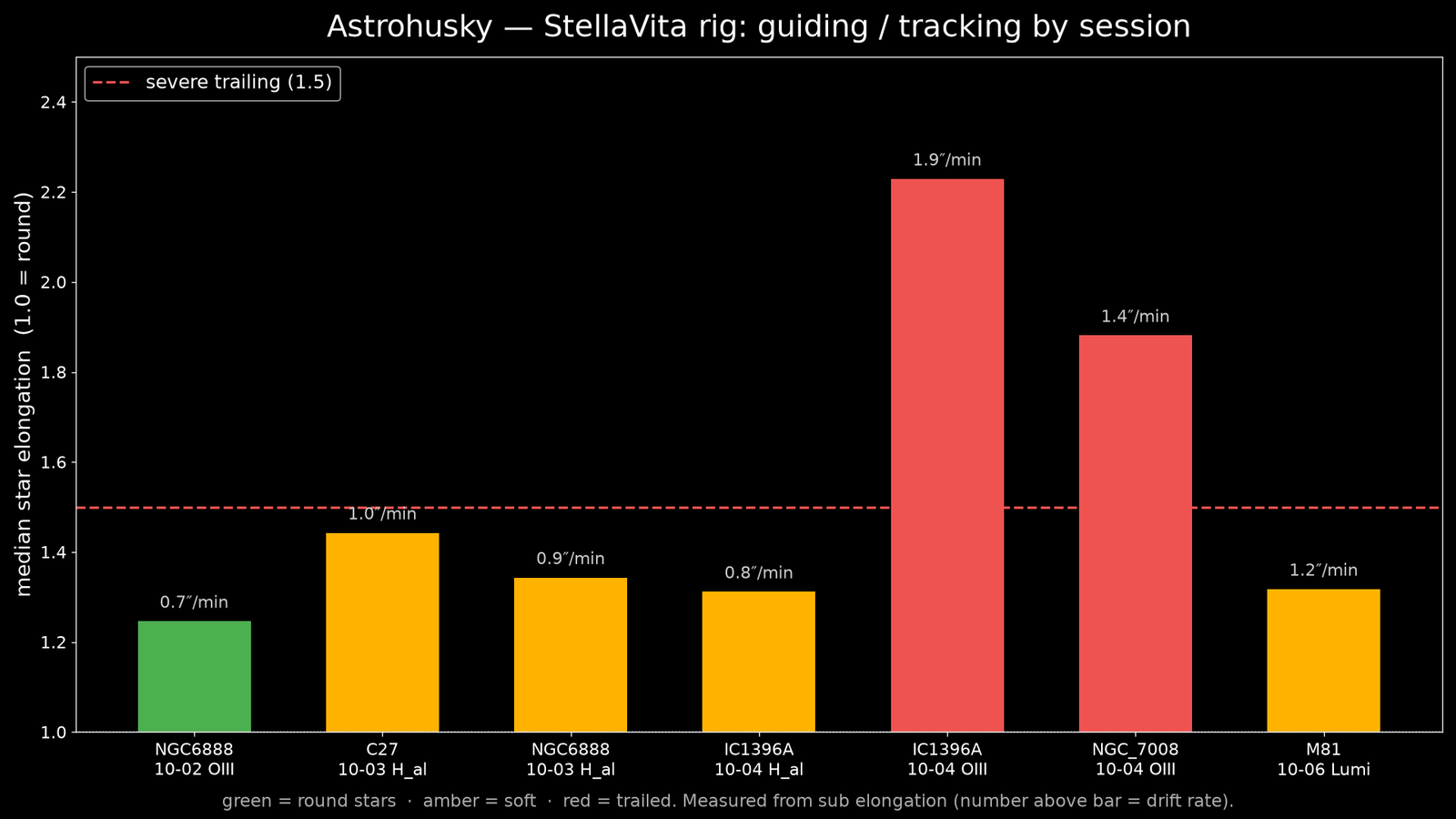
The StellaVita + 200PDS rig raises an interesting puzzle: the autoguider reports an excellent ~0.88″ total RMS (RA 0.58″, Dec 0.66″), yet the light frames themselves still trail. The chart below shows the median star elongation measured directly from the subs on each recent session — 1.0 would be perfectly round — with the per-session drift rate labelled above each bar.
| Target | Date | Filter | Subs | Median elong. | Trail | Drift |
|---|---|---|---|---|---|---|
| NGC 6888 | 2026-10-02 | OIII | 20 | 1.25 | 3.3″ | 0.7″/min |
| NGC 6888 | 2026-10-03 | Hα | 10 | 1.34 | 4.4″ | 0.9″/min |
| C/2026 A2 (comet) | 2026-10-03 | Hα | 10 | 1.44 | 5.2″ | 1.0″/min |
| IC 1396A | 2026-10-04 | Hα | 50 | 1.31 | 3.8″ | 0.8″/min |
| IC 1396A | 2026-10-04 | OIII | 18 | 2.23 | 9.5″ | 1.9″/min |
| NGC 7008 | 2026-10-04 | OIII | 1 | 1.88 | 7.2″ | 1.4″/min |
| M81 | 2026-10-06 | Lum | 8 | 1.32 | 3.7″ | 1.2″/min |
The gap between a happy guider and smeared images is the textbook signature of differential flexure (the guide scope and the main OTA flexing independently) and/or mirror flop in the Newtonian — not polar alignment, Dec backlash, or guiding error. The drift is always in a single, consistent direction, which rules out wind and random seeing. Short narrowband OIII subs on long nights are hit hardest (the rig uses a separate guide scope, not an off-axis guider, so the guider literally cannot see the main-OTA drift). The practical fix is to tighten the guide-scope mounting, check the primary-mirror clips, and ultimately move to an off-axis guider; meanwhile, shorter subs on bright targets keep the trailing in check.