← gallery
NGC 6888 (Caldwell 27) · Emission Nebula (Wolf-Rayet bubble)
Crescent Nebula
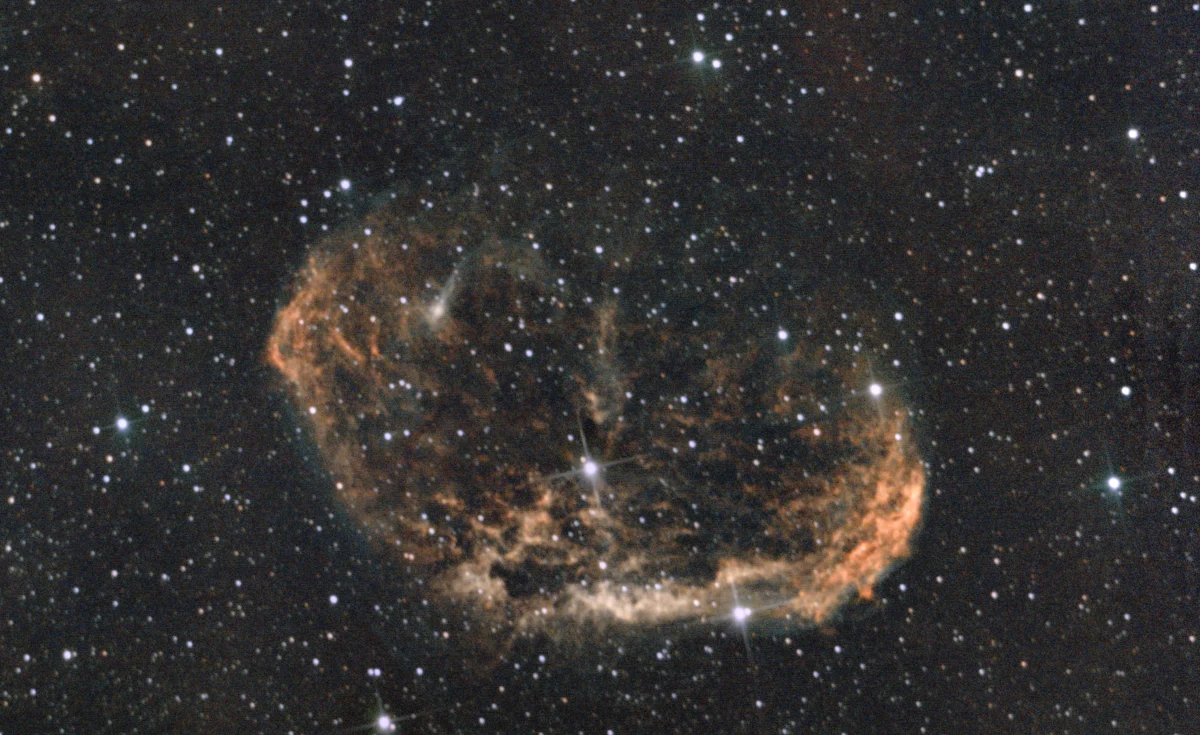
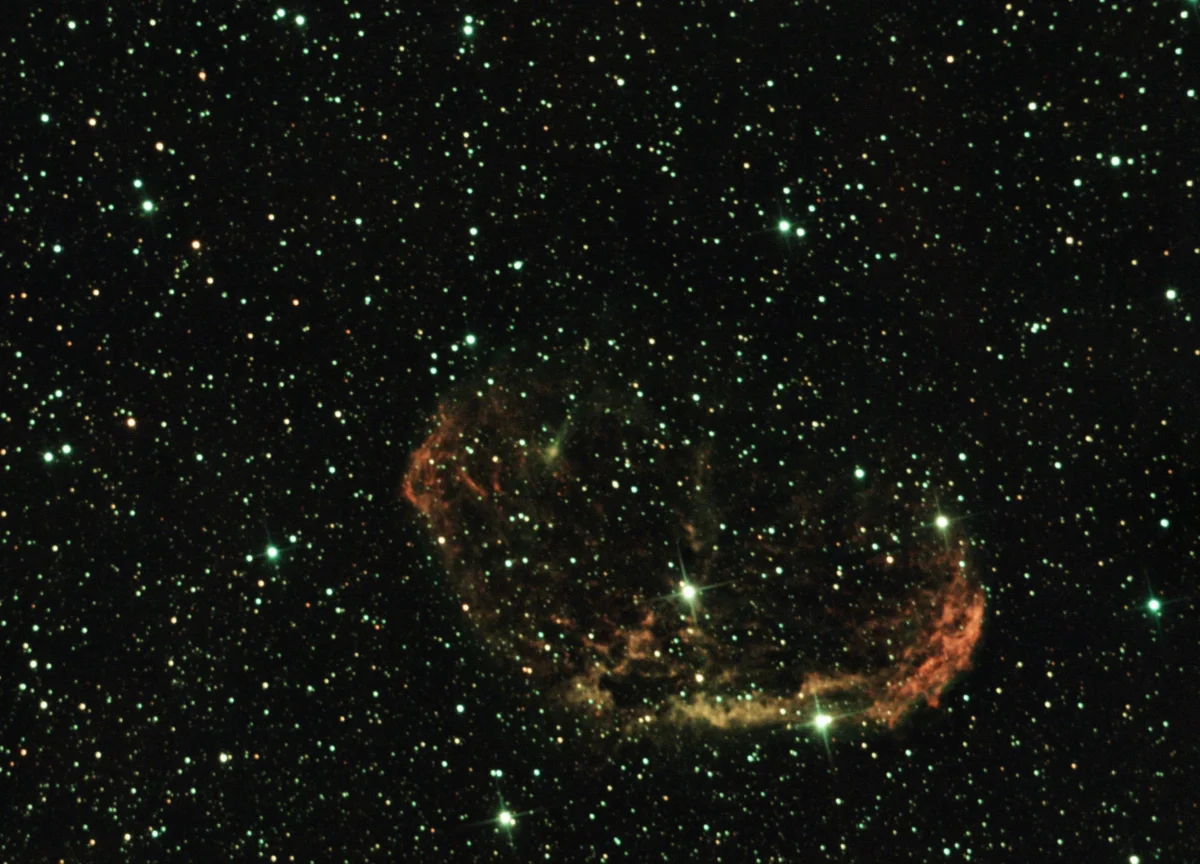
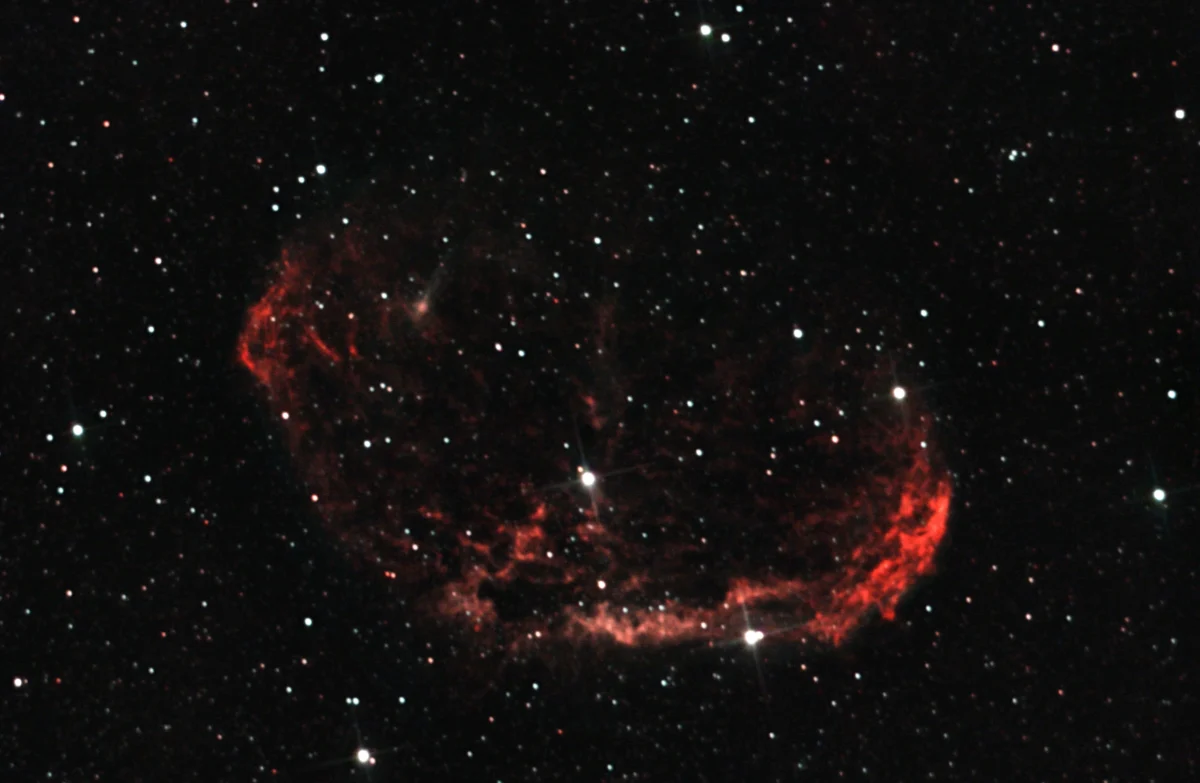
A wind-blown bubble of shocked gas in Cygnus, sculpted by the powerful stellar wind of the Wolf-Rayet star WR 136. The bright shell is the leading edge where the wind ploughs into older material the star shed before it became a Wolf-Rayet.
NGC 6888 is one of the best examples in the sky of what happens shortly before a massive star explodes as a supernova. The central engine, WR 136, is a Wolf-Rayet star — a stripped, intensely hot remnant of a once-much-more-massive O-star. WR 136 is shedding mass at roughly a million times the rate of the solar wind, at velocities approaching 1,700 km/s.
That fast wind is currently sweeping up the slower, denser material the star ejected during its earlier red-supergiant phase. The collision shocks the gas to millions of degrees, producing the bright crescent-shaped shell visible in Hα and OIII. The filaments are clumps where the swept-up shell has become Rayleigh-Taylor unstable. In another few hundred thousand years WR 136 is expected to end its life as a Type Ib supernova — meaning the Crescent is, essentially, a slow-motion preview of a supernova progenitor.
The object is small (about 18 × 12 arcminutes) and sits in a rich part of Cygnus near Sadr (γ Cygni). It responds strongly to narrowband and dual-band filters, but even broadband OSC imaging from a dark sky can pull out the bright leading shell.
That fast wind is currently sweeping up the slower, denser material the star ejected during its earlier red-supergiant phase. The collision shocks the gas to millions of degrees, producing the bright crescent-shaped shell visible in Hα and OIII. The filaments are clumps where the swept-up shell has become Rayleigh-Taylor unstable. In another few hundred thousand years WR 136 is expected to end its life as a Type Ib supernova — meaning the Crescent is, essentially, a slow-motion preview of a supernova progenitor.
The object is small (about 18 × 12 arcminutes) and sits in a rich part of Cygnus near Sadr (γ Cygni). It responds strongly to narrowband and dual-band filters, but even broadband OSC imaging from a dark sky can pull out the bright leading shell.
// imaging sessions
session // unassigned
// comments
Comments are moderated; first time may take a moment to appear.