// 18 October 2026
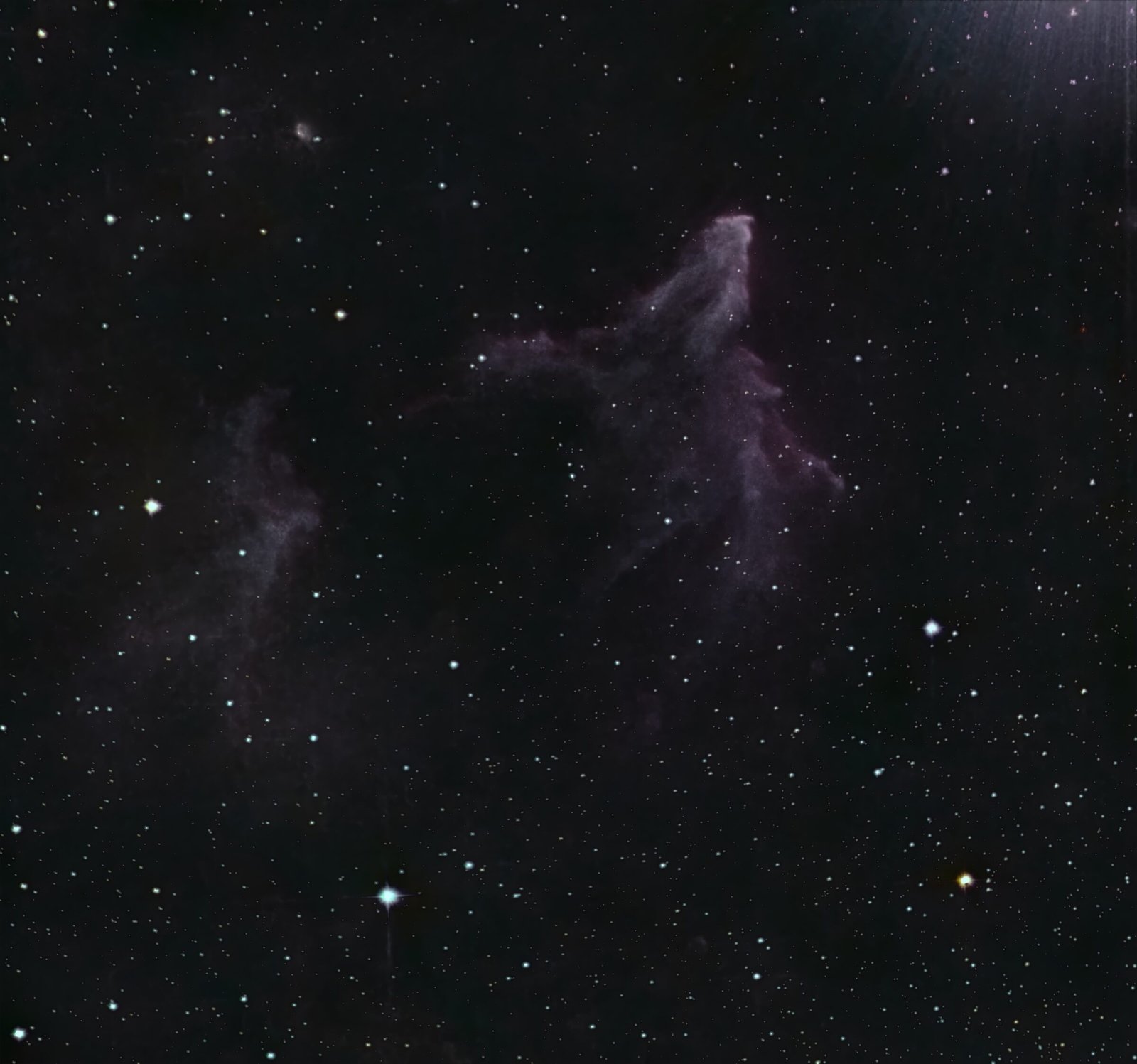
The Ghost of Cassiopeia — SH2-185 in LRGB (IC 63 & IC 59)
Two faint dust clouds beside the bright star Gamma Cassiopeiae — IC 63 and IC 59. One autumn night of LRGB, and a single hot star both lighting the dust blue and burning its edges red.
A few degrees from γ Cassiopeiae — the bright star in the middle of the “W” everyone knows — sit two faint smudges of dust most people never notice: IC 63 and IC 59. Together they’re nicknamed the Ghost of Cassiopeia, and they’re a lovely demonstration of one star doing two different things to the gas around it at once. This is my first LRGB attempt at them — a single autumn night from the backyard.
One star, two effects
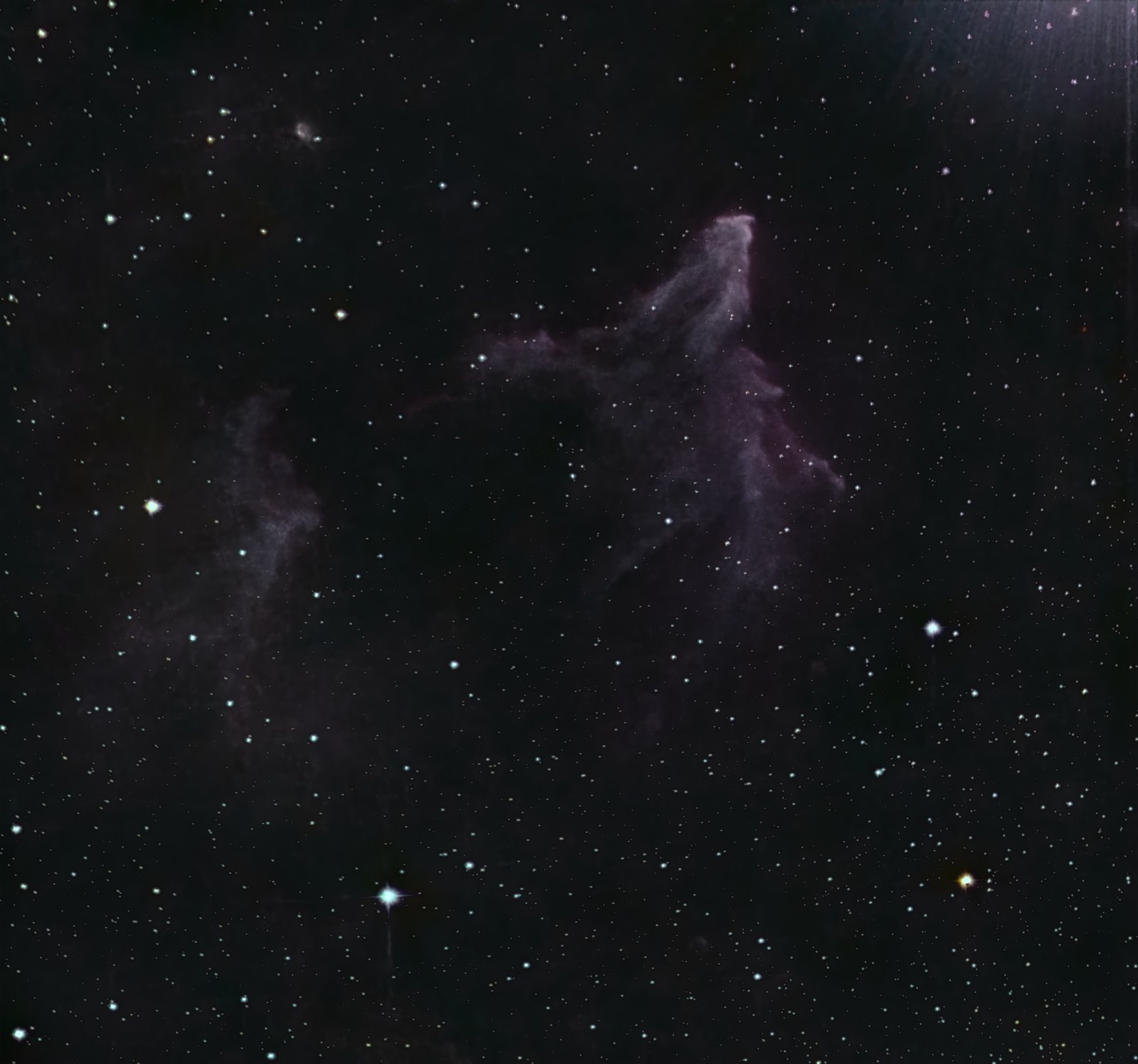
γ Cassiopeiae is a hot, blue, wildly luminous star only about 550 light-years away — and these clouds drift just three or four light-years from it. That proximity is the whole story. The star’s ultraviolet light both lights the dust, scattering blue like a reflection nebula, and tears the hydrogen apart at the cloud edges, which glow red as the atoms recombine. IC 63, the brighter “ghost,” is close enough that the red Hα rim dominates; IC 59, a little farther out, stays bluer and softer. The star itself sits just off the top-right of my frame — close enough that its glare had to be dealt with in processing.
What went into it
The usual backyard rig: the Sky-Watcher 200PDS Newtonian with a coma corrector, the ToupTek ATR533M mono camera at −10 °C and gain 100, on the Wave 150i mount and guided through an off-axis guider. Shot in luminance plus red, green and blue:
- Luminance: 32 × 90 s
- Red: 50 × 120 s
- Green: 58 × 120 s
- Blue: 12 × 120 s
- ~4.8 hours total, calibrated and integrated per channel, then combined into LRGB
One honest caveat. The blue is thin — only twelve good subs. Cloud rolled in before I could finish it, and a later attempt to top it up came out mis-framed and had to be thrown away. In an LRGB image the luminance carries all the detail, so colour noise is forgiving — but blue is the limiting channel here, and it’s the first thing I’ll re-shoot when the weather cooperates. γ Cassiopeiae’s glare also had to be subtracted as a background gradient, so the delicate nebulosity could be stretched without the whole frame washing magenta.
The nebula on its own
With the stars removed, the shape that earns the nickname comes through more clearly — the bright comet-like head of IC 63 pointing back toward the star that’s slowly eroding it, with the fainter western wisp of IC 59 off to the side.
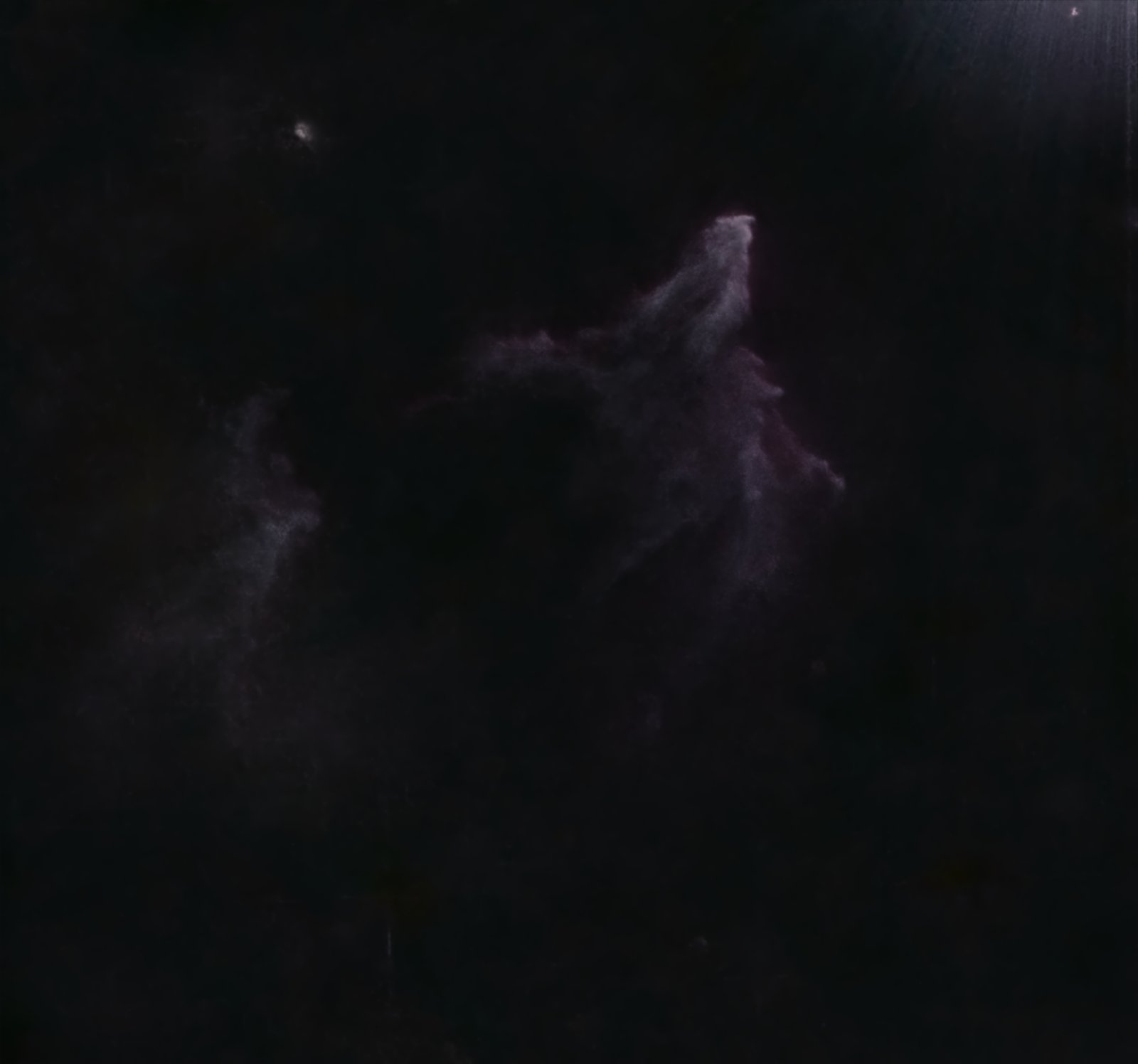
The full set — the labelled version, a field star chart and the starless frame — lives in the SH2-185 gallery album. It’s a “good for one night” image rather than a deep one, but the Ghost is a target I’ll keep coming back to.
// comments
Comments are moderated; first time may take a moment to appear.