// 18 November 2026
Two Asteroids Crossed My Pleiades Photos — Laurentia & Esperanto
Two real asteroids, Laurentia and Esperanto, drifting past the Pleiades in my backyard frames — and three more found in my archive.
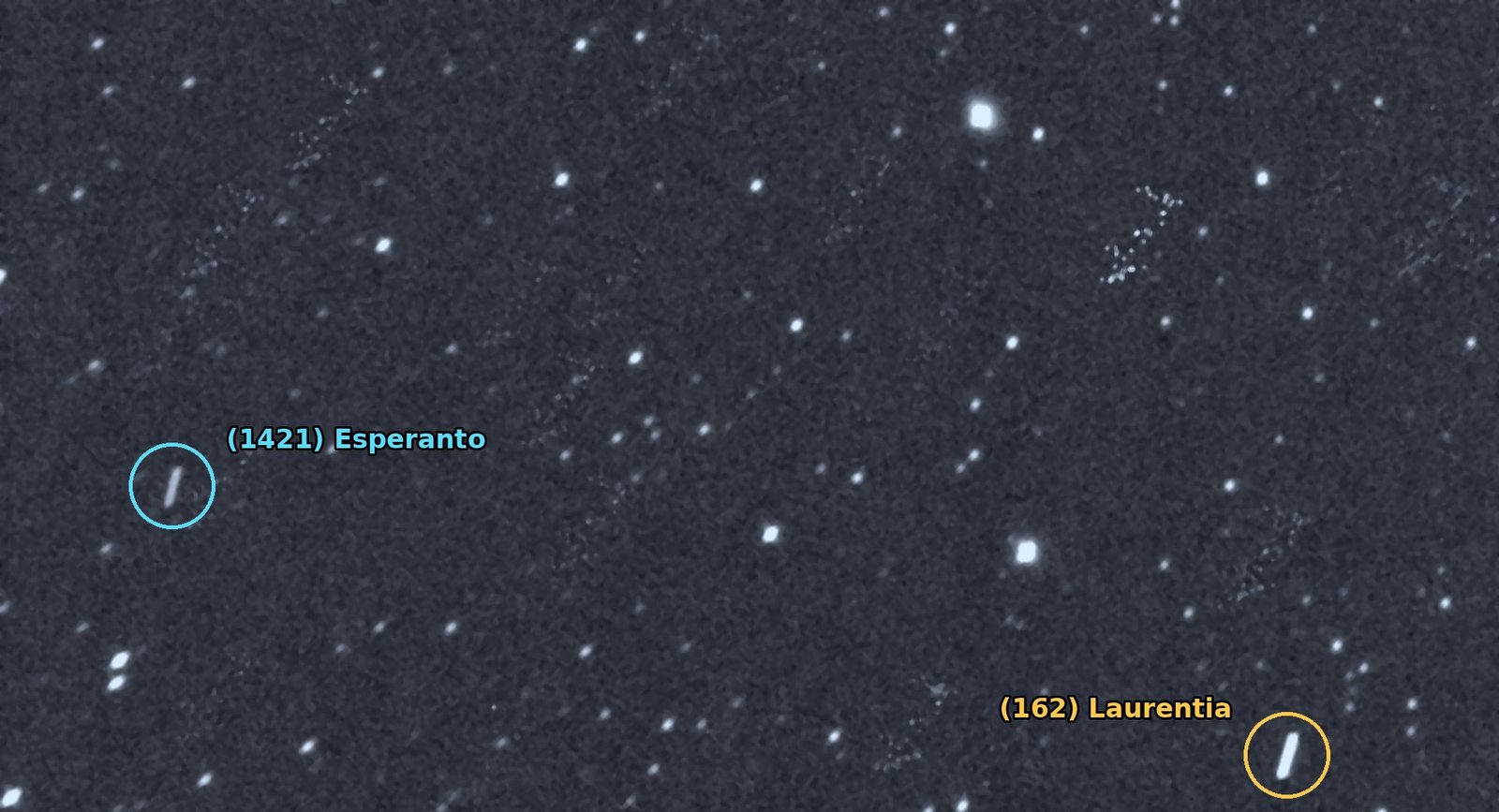
On the night of 13 November 2026 I was photographing a mosaic of the Pleiades from my back garden in northern Germany. Hidden in those frames were two little dots that are not stars at all. They are asteroids from the main belt between Mars and Jupiter, (162) Laurentia and (1421) Esperanto, drifting past the Seven Sisters about 300 million kilometres away. I didn’t notice them while imaging — they only showed up when I searched every frame afterwards.
Meet the two asteroids
(162) Laurentia is the brighter one (magnitude 13.5). It was discovered in 1876 by Prosper Henry in Paris. It is about 97 km across and very dark: it reflects only around 5 % of the sunlight that reaches it. That night it was 294 million km from Earth, so its light took more than 16 minutes to reach my camera.
(1421) Esperanto is the fainter one (magnitude 15.5). It was discovered in 1936 in Turku, Finland, and is named after the international language. It is about 43 km across and was 347 million km away. Both need a little more than five years to go once around the Sun, and both moved about half an arcsecond per minute — roughly 34 arcseconds in the hour, less than the apparent size of Jupiter. The next night, my second Pleiades panel caught Esperanto again.
How I found them
I wrote a small search that goes through every single frame. It finds all the stars, lines the frames up on them, and then looks for points of light that are not on the star list and that move in a straight line at a steady speed. Along the way it throws out warm pixels (they stay on the same spot of the sensor), noise and satellite trails. Every surviving track was then checked against the IMCCE SkyBoT service, which knows where every catalogued asteroid is at any moment. Both tracks matched to within two arcseconds.
The search also measures every known asteroid along its predicted path. That shows how deep the frames go: single 30-second frames reach about magnitude 16.5–17, so the fainter asteroids in the field (there are hundreds, most around magnitude 19–22) stay invisible.
Why the Pleiades?
Most asteroids orbit close to the plane of the planets, so they crowd along the ecliptic. They are closest and brightest near the opposition point, the spot in the sky opposite the Sun — and in November that point lies in Taurus, right next to the Pleiades. In the same search, a field in Cepheus far from the ecliptic contained no known asteroids at all, while the Pleiades field had more than 300.
More asteroids from my archive
After this I ran the same search over everything my StellaVita recorded since early October: 57 sessions and 2,557 frames. Three more asteroids turned up in single frames:
- (83) Beatrix, magnitude 12.4 — about 111 km across, discovered in 1865 in Naples, 243 million km away (Pleiades mosaic, 6 November).
- (1574) Meyer, magnitude 15.2 — about 58 km across, from the outer main belt, discovered in 1949 in Algiers, 381 million km away (Pleiades, 12 November).
- (122412) 2000 QV91, magnitude 18.8 — only a few kilometres across and my faintest catch so far, near M33 on a cloudy night (15 October).
All five asteroids, 10 seconds each
Each short shows my real frames, aligned on the stars, with the asteroid circled as it creeps past them. Press play — each one runs through a whole session in about ten seconds.
The same frames also recorded more than ten known eclipsing and contact binary stars dimming and brightening, among them V Tri in the M33 field and AH Tau next to the Pleiades. No unknown asteroid or new variable star turned up — but the search is ready for the next clear night.
Gear
- Mount: Sky-Watcher Wave 150i (strain-wave)
- Telescope: Sky-Watcher Evostar 72ED (about 430 mm focal length)
- Camera: ToupTek 183CA (G3CMOS20000KPA, Sony IMX183 colour)
- Guiding: 50 mm guide scope with a ToupTek GPCMOS02000KPB
- Control and capture: ToupTek StellaVita AstroStation
- Session: 100 × 30 s at gain 100, 13 November 2026
There is also a 30-second version for phones: 2 Asteroids Hiding in My Pleiades Photo. Clear skies!
// comments
Comments are moderated; first time may take a moment to appear.