← gallery
IC 1805 (Sharpless 2-190) · Emission Nebula
Heart Nebula
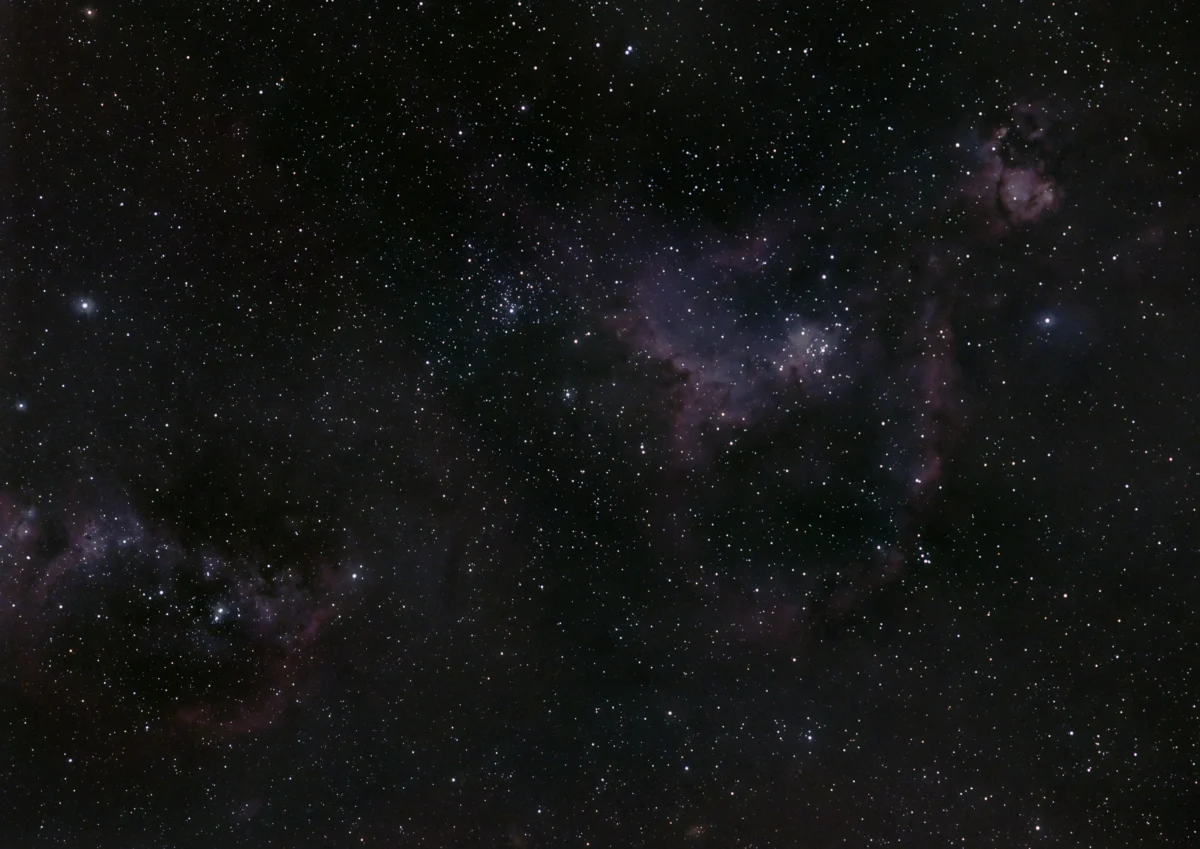
A vast glowing cloud of hydrogen in Cassiopeia, shaped like a valentine heart and powered by the young star cluster Melotte 15 at its core.
IC 1805 spans more than two degrees of sky — five full Moons wide — in the rich Milky Way fields of Cassiopeia. Its characteristic heart shape is sculpted by the open cluster Melotte 15, a knot of hot, massive young stars only a couple of million years old whose fierce radiation and stellar winds ionise the surrounding hydrogen and carve the dark dust pillars that thread the nebula.
Lying roughly 7,500 light-years away in the Perseus spiral arm, the Heart glows mainly in the deep red of hydrogen-alpha, with traces of oxygen and sulphur that narrowband imagers use to build the classic 'Hubble palette' rendition. Its near neighbour IC 1848, the Soul Nebula, sits just to the south-east; the pair are often framed together as the 'Heart and Soul'.
Because the nebula is so large and faint it is a wide-field target — a short refractor, camera lens or finder scope captures the whole heart in one frame. This is an early, broadband wide-field attempt; the faint emission rewards much longer integration and a hydrogen-alpha filter.
Lying roughly 7,500 light-years away in the Perseus spiral arm, the Heart glows mainly in the deep red of hydrogen-alpha, with traces of oxygen and sulphur that narrowband imagers use to build the classic 'Hubble palette' rendition. Its near neighbour IC 1848, the Soul Nebula, sits just to the south-east; the pair are often framed together as the 'Heart and Soul'.
Because the nebula is so large and faint it is a wide-field target — a short refractor, camera lens or finder scope captures the whole heart in one frame. This is an early, broadband wide-field attempt; the faint emission rewards much longer integration and a hydrogen-alpha filter.
// imaging sessions
session // unassigned
// comments
Comments are moderated; first time may take a moment to appear.