← gallery
M42 (NGC 1976) · Emission Nebula
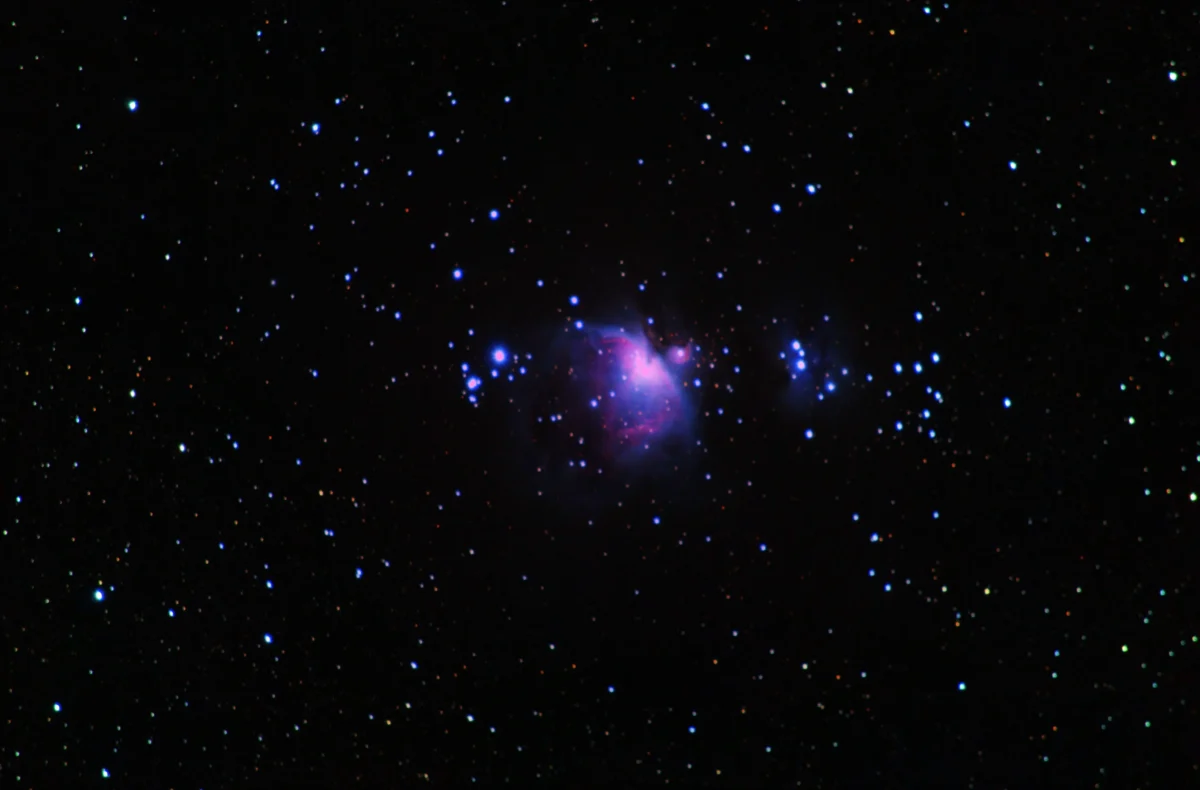
Orion Nebula
The brightest diffuse nebula in the sky and the closest large star-forming region to Earth — a glowing stellar nursery visible to the naked eye in Orion's sword.
The Orion Nebula is the nearest region of massive star formation to the Sun, about 1,340 light-years away, and one of the most studied objects in the entire sky. It is the bright middle 'star' of the three that hang from Orion's Belt — a vast cloud of gas and dust roughly 24 light-years across where new stars are being born right now.
At its heart sits the Trapezium, a tight cluster of hot young stars whose ultraviolet radiation lights up the surrounding hydrogen and carves glowing cavities and dark pillars of dust. Embedded protoplanetary disks ('proplyds') around many of the cluster's stars are nascent solar systems caught in the act of forming.
The nebula's enormous brightness range — from the searingly bright Trapezium core to faint outer tendrils — makes it a classic high-dynamic-range target. This wide-field view also catches the blue Running Man Nebula (NGC 1977) just to the north. Even short exposures reveal vivid colour, which is why M42 is the object almost every astrophotographer images first.
At its heart sits the Trapezium, a tight cluster of hot young stars whose ultraviolet radiation lights up the surrounding hydrogen and carves glowing cavities and dark pillars of dust. Embedded protoplanetary disks ('proplyds') around many of the cluster's stars are nascent solar systems caught in the act of forming.
The nebula's enormous brightness range — from the searingly bright Trapezium core to faint outer tendrils — makes it a classic high-dynamic-range target. This wide-field view also catches the blue Running Man Nebula (NGC 1977) just to the north. Even short exposures reveal vivid colour, which is why M42 is the object almost every astrophotographer images first.
// imaging sessions
session // unassigned
// comments
Comments are moderated; first time may take a moment to appear.