// 25 June 2026
Imaging M33, the Triangulum Galaxy — a two-night build log
How I captured the Triangulum Galaxy across two nights from a Bortle 3 site with a Sky-Watcher 200P and a one-shot-colour camera — gear, sessions and processing.
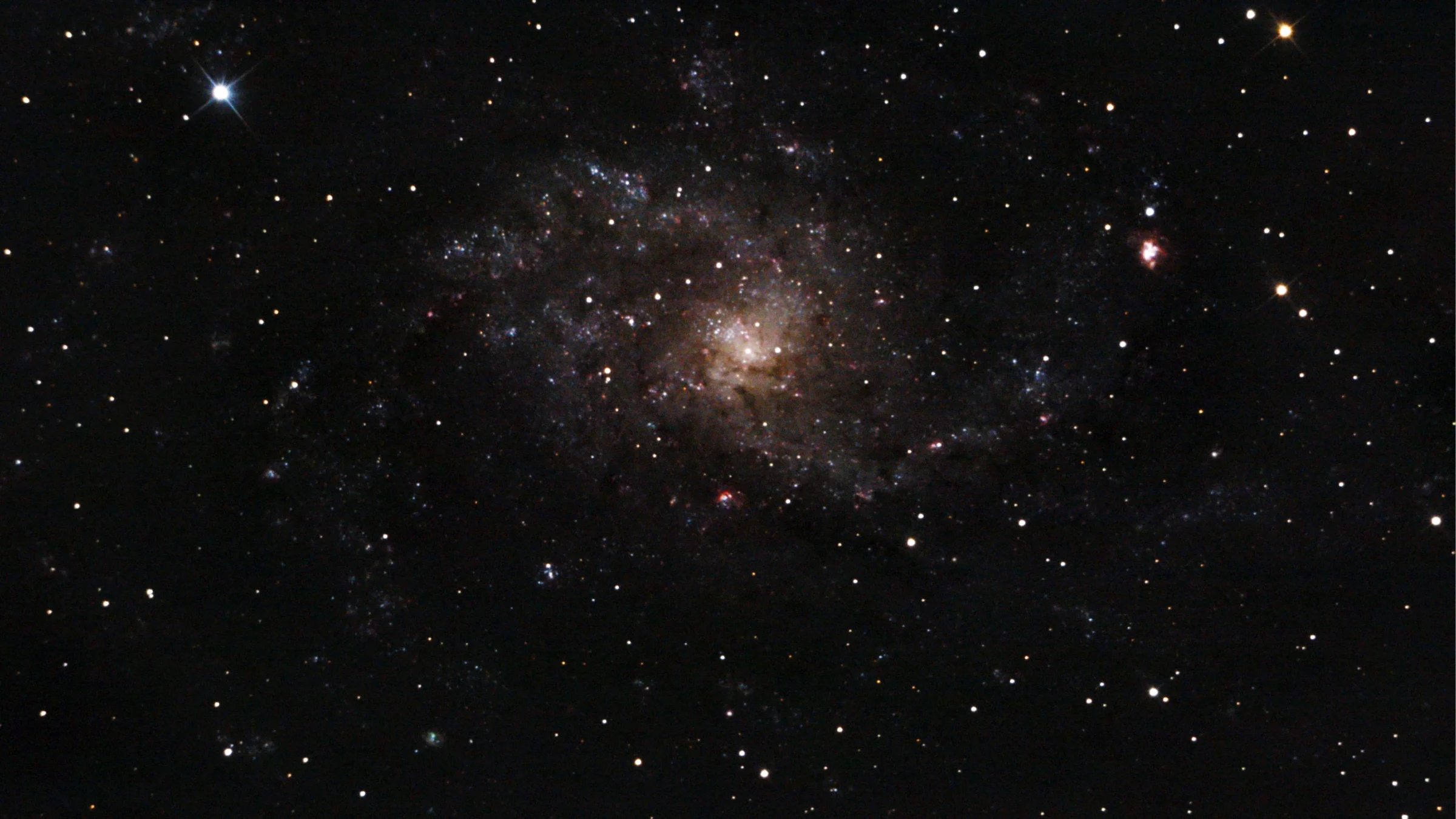
M33 is one of those targets that looks easy on paper and humbles you at the eyepiece. At magnitude 5.7 and nearly 70 arcminutes across, the Triangulum Galaxy is technically a naked-eye object from a dark site — but its light is spread so thinly that it is one of the most diffuse, low-surface-brightness objects in the Local Group. You don’t fight to find it; you fight to pull it out of the background. This is the story of how I imaged it across two nights from Bortle 3 skies, and how the processing came together.
The target
The Triangulum Galaxy sits about 2.7 million light-years away — slightly farther than Andromeda — and together with M31 and the Milky Way forms the gravitational backbone of the Local Group. It is a face-on spiral, which is exactly what makes it both beautiful and difficult: all that structure is laid out flat for the camera, but the surface brightness is low enough that it rewards one thing above all else — total integration time.
It is also studded with giant star-forming HII regions. The standout is NGC 604, a glowing pink hydrogen complex roughly 1,500 light-years across — one of the largest known star-forming regions in the local universe, and big enough to carry its own catalogue number. Catching it as a distinct pink knot in the outer arms became my informal “did it work?” test for the whole project.
The rig
Nothing exotic here — a workhorse Newtonian setup:
- Optics: Sky-Watcher Explorer 200P Newtonian + TS-Optics 2-inch Newtonian coma corrector
- Mount: Sky-Watcher EQ5 Pro SynScan GoTo
- Camera: ToupTek 183CA (one-shot-colour), gain 100, no filters — bare OSC broadband
- Focus & guiding: Pegasus Astro Gemini EAF autofocuser, 50/90 mm guide scope, ToupTek 327C Mini guide camera
- Software: N.I.N.A. for capture, PHD2 for guiding, Siril for stacking and processing, GIMP for the finishing pass
Shooting M33 in broadband one-shot-colour rather than narrowband is the right call for a galaxy — the spiral arms and the blue OB associations are broadband targets, and the HII regions still come through without dedicated H-alpha.
Two nights at a dark site
Both sessions were shot from Mecklenburg-Vorpommern, Mecklenburg-Vorpommern, in Mecklenburg — a Bortle 3 site, which is the single biggest reason this came together. Dark skies do for low-surface-brightness galaxies what no amount of processing can fake.
Night one — 6 September 2025: a little over four hours of total integration. Enough to get a clean colour master, see the dust lanes, and confirm NGC 604 was sitting right where it should be in the upper-east of the disc.
Night two — 11 October 2025: I came back for roughly another four hours, this time framing a tighter crop on the spiral structure to go deeper on the core and the inner arms than the September data allowed.
Stacking each night separately gave me two masters to work from — and a useful before/after on how much the extra signal actually bought me.
Processing
The processing was the longest part, and it is where most of the iterations in the M33 album come from. The path through Siril was the usual one: calibrate and stack, remove the gradients, run a photometric colour calibration so the star colours anchor everything honestly, then a careful non-linear stretch to lift the faint outer arms without blowing out the warm reddish-yellow nucleus. GIMP handled the final balancing pass.
The album shows the journey deliberately — an early single-channel-style stretch emphasising raw structure, the calibrated colour master, a couple of alternate stretches pulled further on the faint outer regions, and the final balanced export where the HII knots along the arms read most clearly.
What I’d do differently
More time. M33 always wants more time. Eight or ten hours would have smoothed the outer-arm noise and let me push the faint tidal structure harder. But for around eight hours total across two nights with an OSC camera and no filters, from genuinely dark skies, the Triangulum Galaxy delivered exactly what it is famous for.
See the full set, including the deep-zoom versions and acquisition data for each frame, in the M33 — Triangulum Galaxy album.
// comments
Comments are moderated; first time may take a moment to appear.