// 26 June 2026
Imaging NGC 6543, the Cat’s Eye Nebula — When Dawn Turns Your Frames White
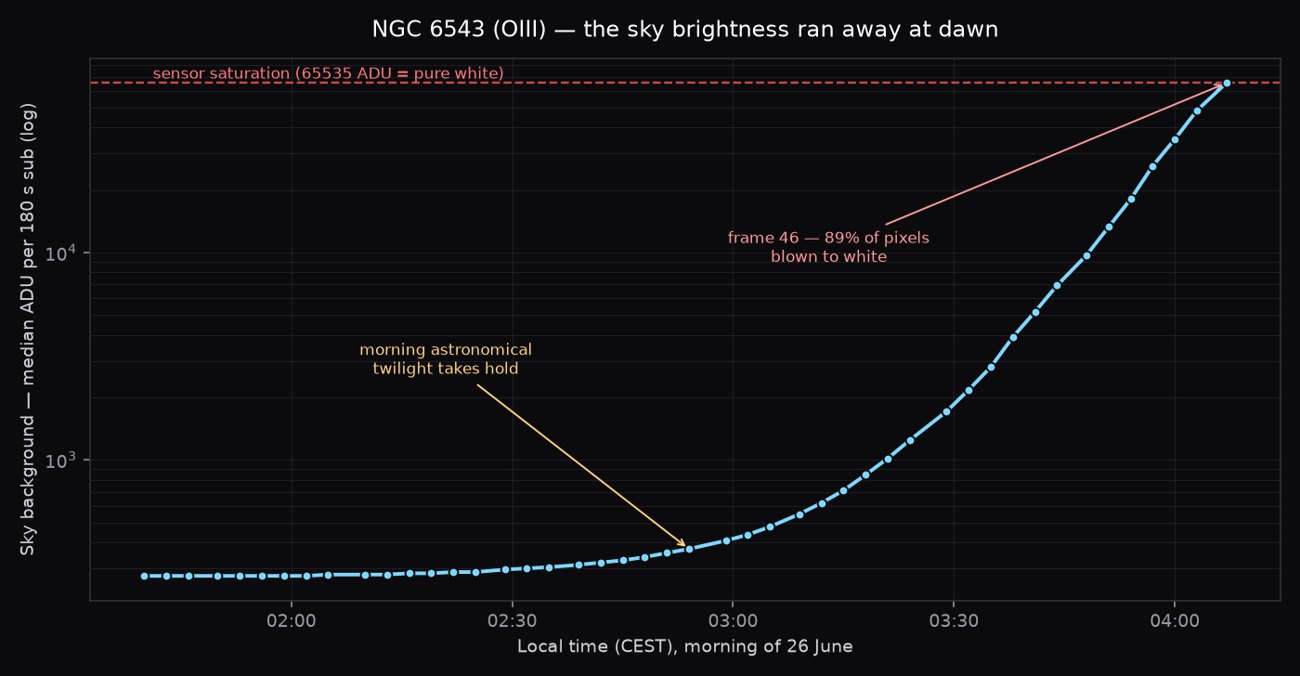
A summer build log on the Cat’s Eye Nebula (NGC 6543): 46 OIII subs with a Sky-Watcher 200PDS, and the per-frame data showing how dawn near the solstice drove the sky from 280 ADU to a pure-white 65,535 by 04:07.
Some nights you call the end of a session. Last night, the sky called it for me. I was an hour and a half into a narrowband run on NGC 6543 — the Cat’s Eye Nebula — when the frames quietly stopped being astrophotos and started being sheets of white paper. Not a fault, not a dewed-up corner: the sky itself had filled the well of every pixel. This is a short build log of how the night went, and the data behind exactly when and why it went white.
The target and the rig
NGC 6543 sits at declination +66° in Draco, which from my latitude means it’s high and effectively circumpolar — a sensible summer target when the more famous deep-sky objects are still below the horizon or lost in twilight. It’s a planetary nebula: tiny and bright in the core, with a fainter outer halo that rewards real integration time and a clean OIII signal.
The setup for the night:
- Optics: Sky-Watcher 200PDS — 200 mm aperture, 1000 mm focal length, f/5 Newtonian
- Camera: ToupTek ATR533M — mono IMX533, 3.76 µm pixels (about 0.78″/pixel at this focal length)
- Filter: OIII narrowband
- Sub-exposure: 180 s, gain 100, offset 0, sensor cooled to 10 °C
- Run: 46 light frames, 01:40 – 04:10 local (CEST), night of 25–26 June
How the night actually went
For the first stretch it was a textbook session. Guiding settled, focus held, and the sky background sat rock-steady at a median of roughly 276–320 ADU sub after sub — that flat floor is exactly what you want to see, the signature of a dark, stable sky. The Ekos Analyze timeline below shows it: a long, unbroken wall of green capture blocks, with guiding and focus behaving underneath.
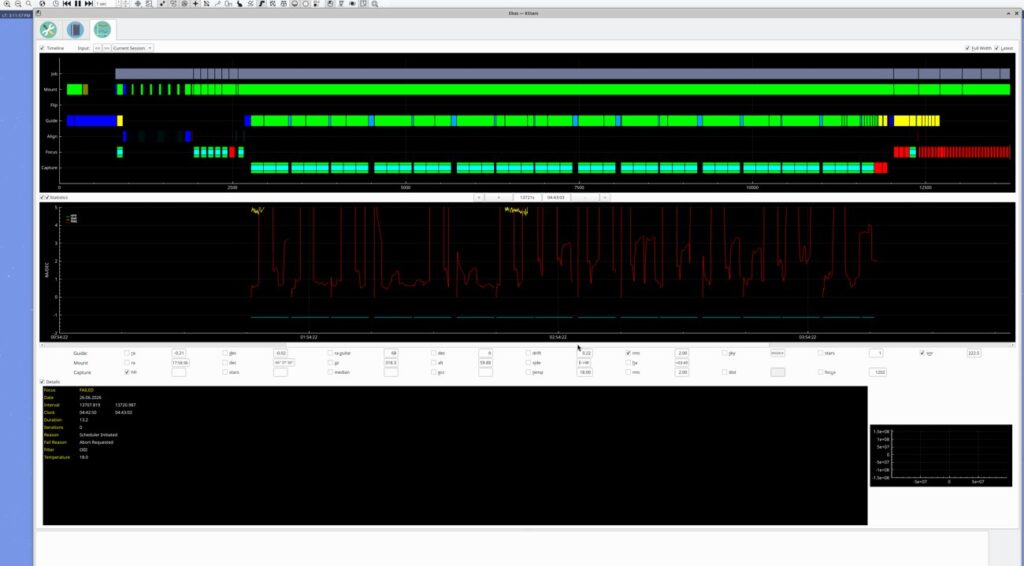
Frames 1 through about 23 — the first ~70 minutes — are the keepers. Then, slowly at first, the floor started to lift.
Then the sky turned white
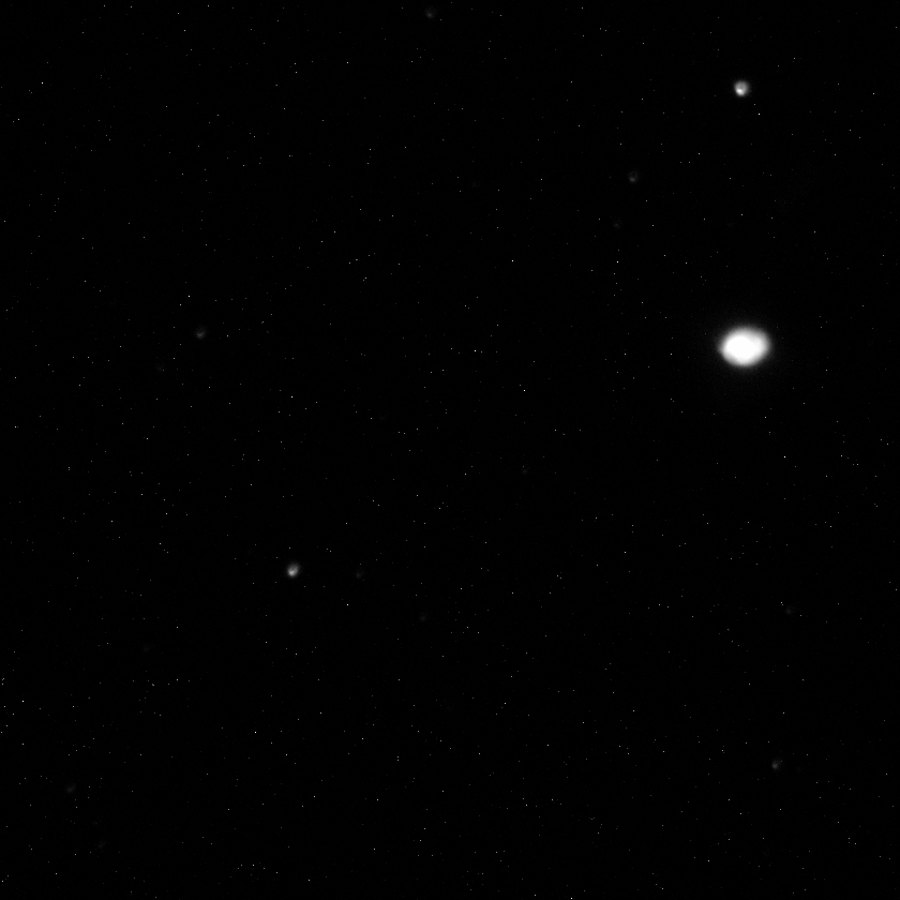
Around 02:45 local the background stopped being flat. It didn’t spike — it accelerated. Each sub came back a little brighter than the last, then a lot brighter. By 03:38 the median had climbed past 3,900 ADU; by 03:54 it was 18,000; by 04:00, 35,000. The final frame, at 04:07, came back with a median of 65,532 — one count short of the sensor’s 16-bit ceiling — with 89% of every pixel in the frame fully saturated to white. The same five subs, shown on one shared brightness scale, tell the whole story:

The data behind the white frame
Because every sub records its own sky background, the run left behind a perfect little dataset. Plotting the median ADU of each of the 46 frames against the clock makes the failure mode unmistakable — a flat floor, an inflection right at the onset of morning twilight, then a near-vertical climb into saturation:
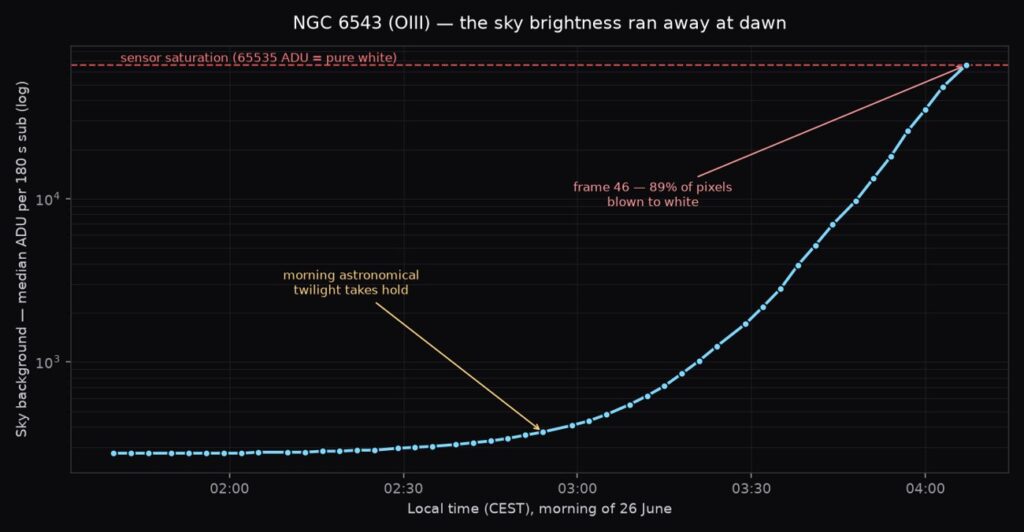
From the dark-sky floor to a pure-white frame, the sky background rose by a factor of more than 230× in about 80 minutes. That’s not a gradual fade — on a log scale it’s an exponential wall, and it’s why the last eight subs are unrecoverable. No amount of stretching pulls signal out of a pixel that’s already pinned at maximum.
Why it happened — the solstice problem
This is the unglamorous reality of deep-sky imaging in late June from northern latitudes: there is barely any astronomical night left. Within a few days of the solstice, the Sun never sinks far enough below the horizon for the sky to fully darken, and morning twilight starts eating into the session absurdly early. I didn’t lose the frames to a cloud or a mistake — I lost them to the calendar. The truly dark window was only ever going to be about an hour and a quarter wide, and the scheduler kept dutifully firing 180-second OIII subs straight into the dawn because nothing told it to stop.
What I’d change next time
- Let the data end the run, not the frame count. A sky-background or twilight-altitude cutoff in the scheduler would have stopped capture cleanly around 02:45 instead of grinding out 20 minutes of white.
- Start earlier and accept the short window. In solstice weeks the dark slot is tiny; better to be on target and guiding before it opens than to chase it.
- Pick targets for the season. High-declination objects like the Cat’s Eye are the right call now — but pair them with a realistic integration goal, not an all-nighter that the sky won’t allow.
- Keep the white frames — as documentation, not data. They make a genuinely useful reference for where my dark-sky window actually closes.
The keepers from the front half of the night are stacking up nicely, and the Cat’s Eye will still be there next clear night — ideally one I start, and end, with a little more respect for how short a June night really is. More frames and finished images are over in the gallery, and if you missed it, here’s the two-night M33 build log from a more cooperative stretch of sky.
// comments
Comments are moderated; first time may take a moment to appear.