// 27 June 2026
Crescent Nebula in OIII — HOO Project, Night 1 (NGC 6888)
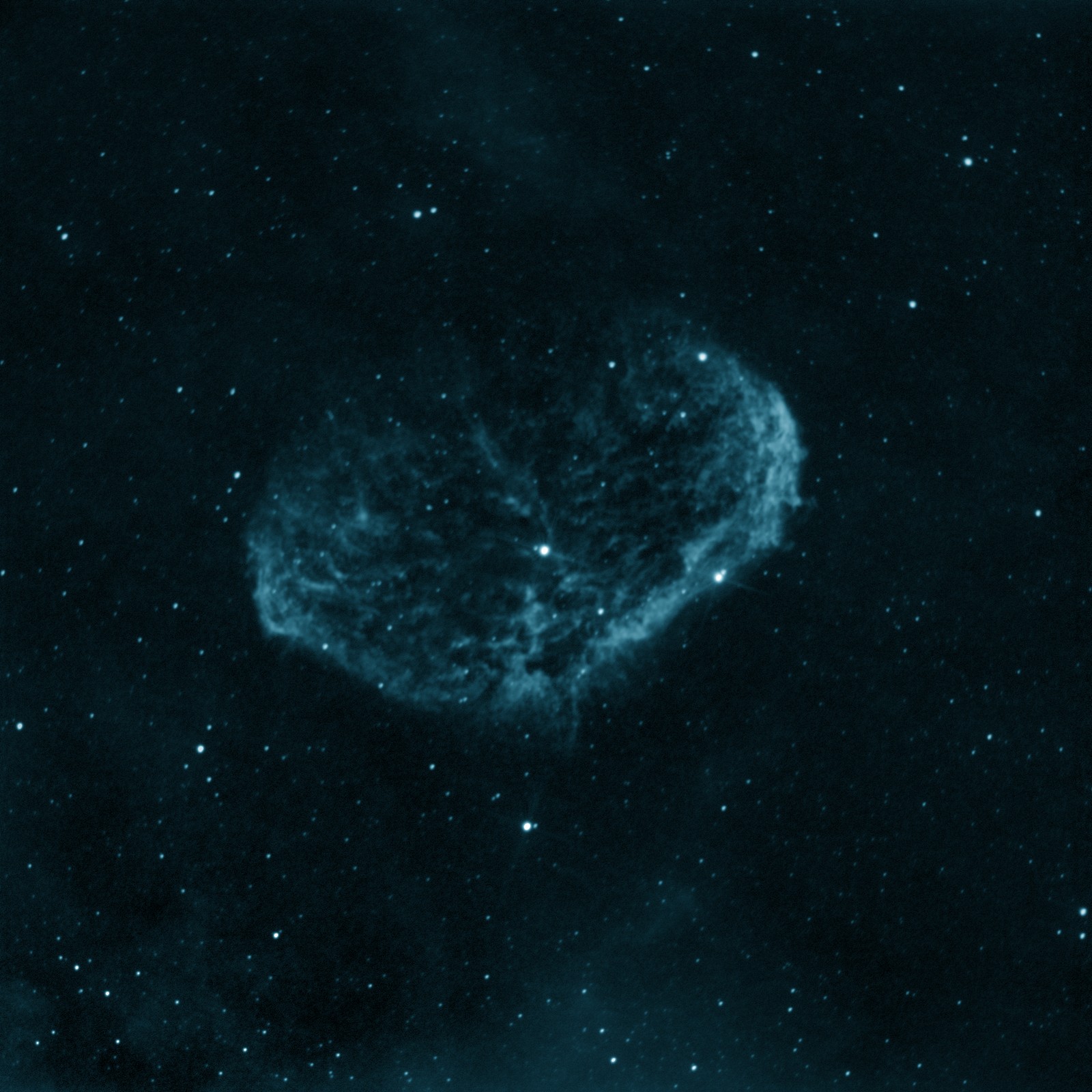
Night 1 of a multi-night HOO project on NGC 6888, the Crescent Nebula: 47 × 180 s of OIII with a Sky-Watcher 200PDS, and the per-sub data showing a sky that dipped to 288 ADU at astronomical midnight and held to within ±4% all night.
This is the start of something longer. Over the next few clear nights I’m building a single deep image of NGC 6888 — the Crescent Nebula — in the classic HOO narrowband palette: hydrogen-alpha mapped to red, doubly-ionised oxygen to green and blue. This is the build log for Night 1, and Night 1 was all about the oxygen. After the last session ended with the sky going pure white at dawn, it was a relief to watch this one simply hold.
A new project — the Crescent, and why HOO
NGC 6888 is an emission nebula in Cygnus, roughly 5,000 light-years away. It’s a Wolf-Rayet bubble: the central star, WR 136, is a massive sun in its death throes, shedding a ferocious stellar wind that has caught up with and slammed into the slower shell of gas it puffed off earlier as a red supergiant. That collision lights the whole structure up — strongly in hydrogen-alpha, and more faintly in the teal glow of doubly-ionised oxygen (OIII).
That two-gas structure is why the Crescent is a textbook HOO target. You shoot two narrowband channels — Hα and OIII — and map them to colour so the red hydrogen shell and the blue-green oxygen envelope each tell their part of the story. The plan for this project is exactly that: a night (or more) of OIII, a night (or more) of Hα, then combine.
I started with OIII deliberately. In the Crescent it’s the harder of the two signals — fainter, and easily lost to a bright sky — so it earns the darkest, steadiest part of the run. And in late June from high-latitude Germany, “the darkest part of the run” is a narrow window indeed.
Night 1 at the scope
Everything was driven with KStars / Ekos — scheduler, plate-solve, autofocus, guiding and capture — on the observatory mini-PC. The rig for the project:
- Optics: Sky-Watcher 200PDS — 200 mm aperture, 1000 mm focal length, f/5 Newtonian
- Camera: ToupTek ATR533M — mono IMX533, 3.76 µm pixels (~0.78″/pixel here)
- Filter: OIII narrowband (Night 1)
- Sub-exposure: 180 s, gain 100, sensor cooled to 10 °C
- Night 1 yield: 47 light frames — 2 h 21 m total — 00:10–02:42 local (CEST), night of 26–27 June
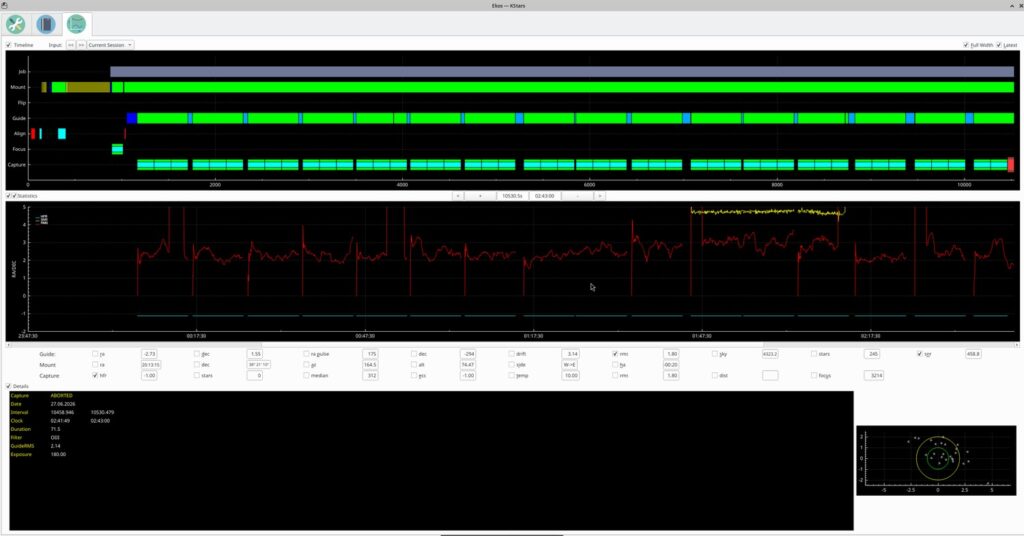
After a plate-solve and a single autofocus run (hyperbola fit, R² = 0.96, best HFR around 2.0 px), the scheduler dropped into a clean rhythm: guide, expose, dither, repeat. The Ekos Analyze tab is the honest record of it — an unbroken wall of green capture and guiding blocks from first light to the end of the window.
The night that held
Here’s the part I didn’t get last time. Sub after sub, the median sky background traced a gentle U: about 308 ADU as the last of dusk drained away, sliding down to a flat floor of 288 ADU right around astronomical midnight, then easing back up to 312 ADU as the first hint of dawn arrived. Total swing across the entire night: about ±4%. That flat, shallow basin is the signature of a genuinely dark, stable sky — and it’s the whole reason the OIII signal is clean.
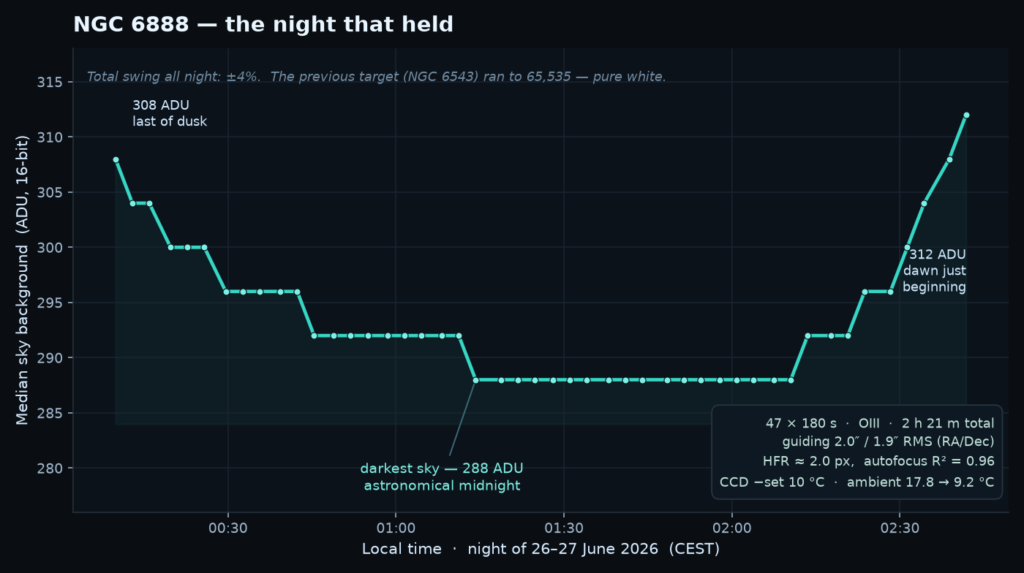
The rest of the vitals matched the calm. Guiding held around 2.0″ RA / 1.9″ Dec RMS on the little 90 mm guide scope — not flawless, but tight enough to keep stars compact in narrowband. Focus needed no intervention after the opening autofocus, helped by a steadily cooling night: ambient fell from 17.8 °C at dusk to 9.2 °C by the end, while the sensor sat locked at its 10 °C set-point.
What the oxygen shows
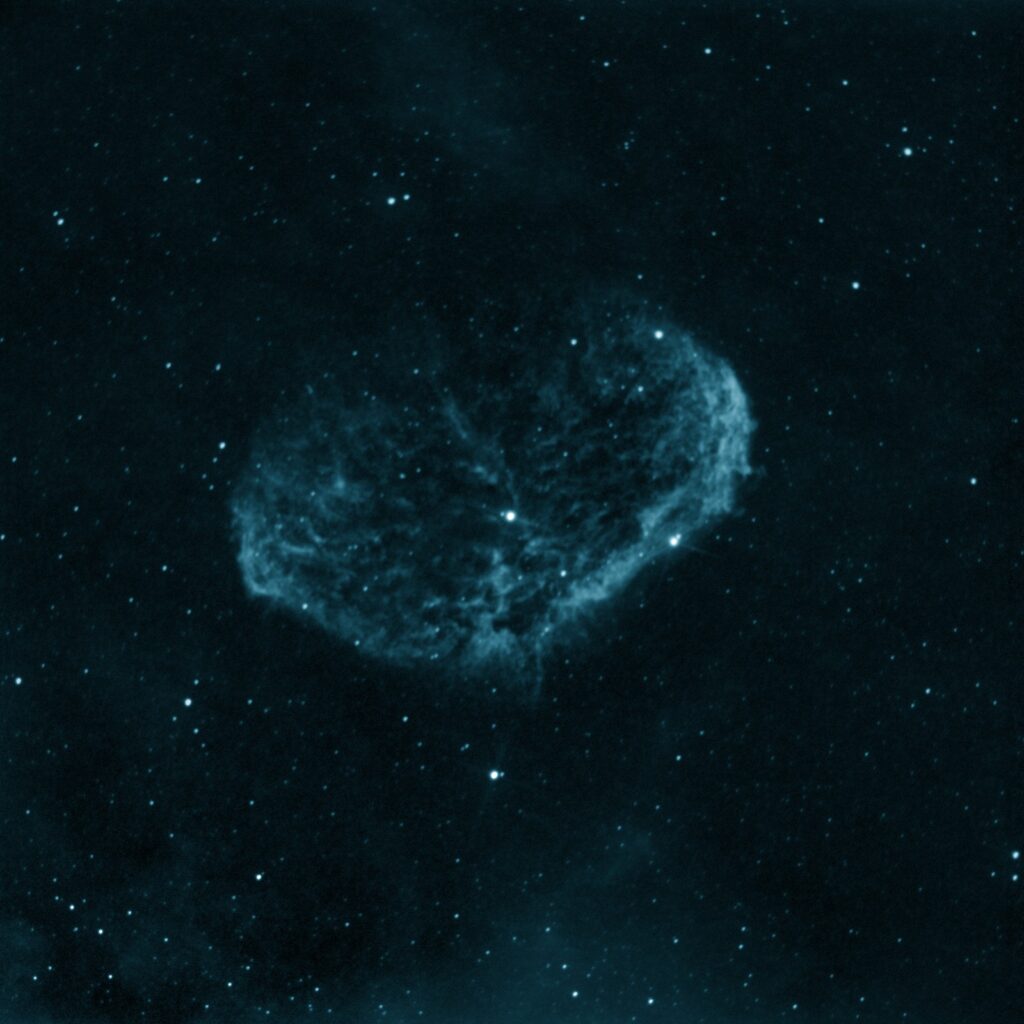
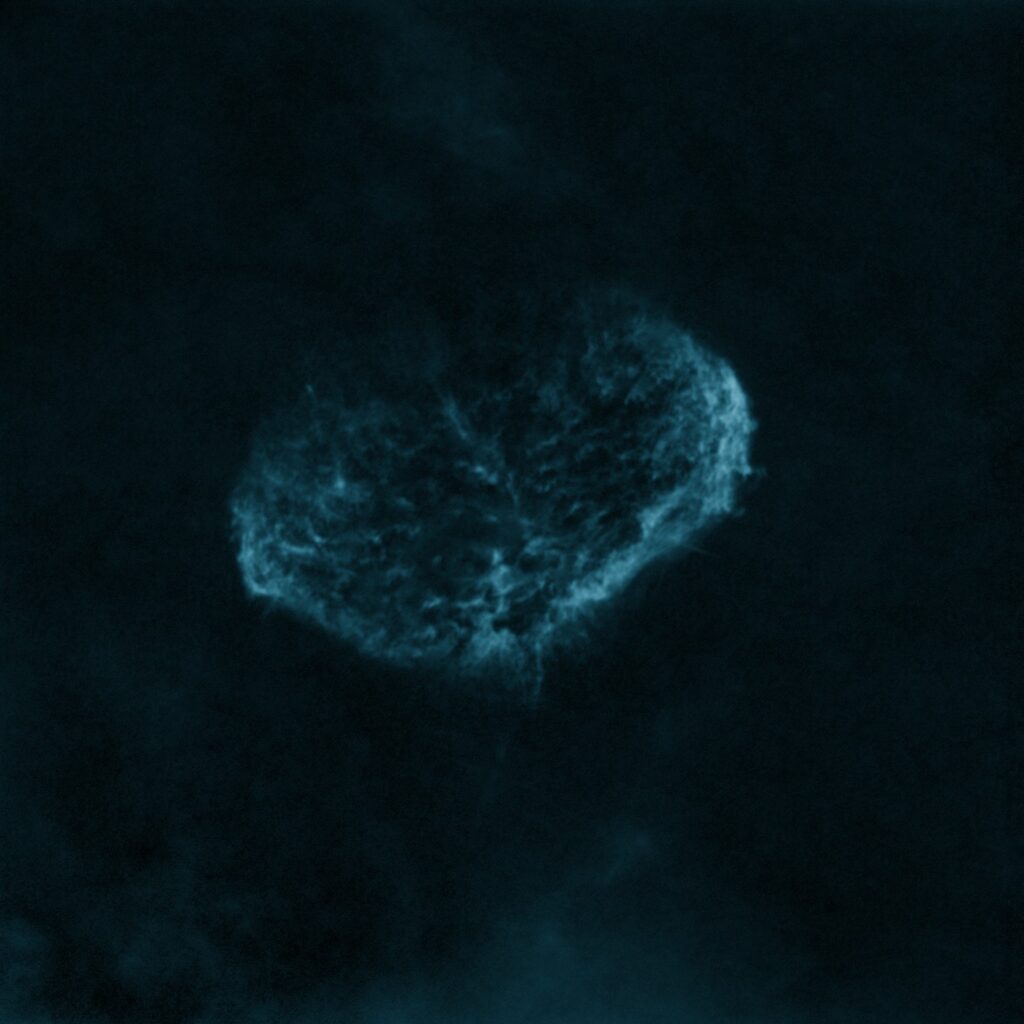
Pull the stars out and the Night-1 data stands on its own. The OIII shell of the Crescent is a tangle of bright filaments and a brighter rim — the shock front where the Wolf-Rayet wind is plowing into the old red-supergiant shell. There’s real structure here already, from a single channel and a single short night, which is a good sign for what the full integration will hold.
Where this is heading — the H-alpha night
Night 1 banks the oxygen. The next clear night is for hydrogen-alpha, which in the Crescent carries the bright braided shell that gives the nebula its name. Combine the two and you get the full HOO image — the gold-and-teal version of the Crescent.
Watch Night 1
The whole night, condensed into 45 seconds — the OIII data, the sky-brightness curve, and the oxygen shell, with narration:
More to come as the project builds. In the meantime, you can browse the finished work in the gallery, or read the companion build log from the night the sky didn’t hold — imaging NGC 6543 as dawn turned the frames white. The rest of the writing lives on the blog.
// comments
Comments are moderated; first time may take a moment to appear.